
Displaying items by tag: Ethan Smith
It's a Wonderful Life: A Live Radio Play Remains a Holiday Treasure at Oil Lamp Theater

This holiday season, Oil Lamp Theater continues one of its most cherished traditions with the 13th annual production of It's a Wonderful Life: A Live Radio Play. A unique hallmark of the company's seasonal offering is its rotating roster of directors, allowing each year's staging to bring a fresh perspective to Joe Landry's beloved adaptation of Frank Capra's timeless classic. This year's installment is helmed by Becca Holloway, following Lauren Katz's turn at the helm last season. Among the many holiday stagings competing for audiences' attention, Oil Lamp's latest rendition should be strongly considered by theatergoers seeking a heartfelt, imaginative, and thoroughly satisfying theatrical outing. Charming, inventive, and filled with genuine heart, it captures both the nostalgic appeal of old-time radio and the emotional power that has made George Bailey's story resonate across generations.
At the center of the story is George Bailey, a man whose lifelong dreams of adventure and success have repeatedly been set aside in service to his family, friends, and townsfolk. As financial troubles mount on Christmas Eve and a devastating setback threatens everything he has built, George finds himself questioning the value of his life and the impact he has had on those around him. In his darkest moment, an unlikely guardian angel named Clarence intervenes, offering George a glimpse of what Bedford Falls might have become had he never existed.
What follows is a moving journey through friendship, sacrifice, love, and second chances as George comes to understand the countless lives he has touched. Through humor, warmth, and moments of profound emotional truth, the story reminds audiences that wealth is not measured in money, but in the relationships we build and the difference we make in the lives of others. Presented through the unique lens of a live radio drama, the familiar tale gains an added layer of nostalgia and theatrical ingenuity, making it feel both comfortingly familiar and surprisingly fresh.
Joe Landry's It's a Wonderful Life: A Live Radio Play was first performed in 1996 at the Stamford Center for the Arts in Stamford, Connecticut. Originally conceived as a traditional stage adaptation of Frank Capra's beloved film, Landry reworked the piece into a 1940s radio broadcast after realizing a full-scale version would be too large and costly to produce. The inspired concept has since become one of the most frequently produced holiday plays in the country. Theatregoers are invited inside a 1940s radio studio where a small troupe of performers creates the world of Bedford Falls through multiple characterizations, vintage sound effects, and theatrical ingenuity. The format also carries a measure of historical authenticity. Shortly after the film's 1946 release, It's a Wonderful Life was adapted for a March 10, 1947 broadcast of Lux Radio Theatre on CBS, with James Stewart and Donna Reed reprising their iconic roles as George and Mary Bailey. By framing the story as a live radio performance, Landry not only found an inventive theatrical solution but also tapped into a genuine chapter of the work's history. Oil Lamp fully embraces that concept through a meticulously crafted 1940s radio studio setting that serves as one of the production's greatest pleasures. Retro commercial interludes are also performed by the cast, adding both lightheartedness and authenticity to the broadcast atmosphere.
Trenton Jones' scenic design transforms Oil Lamp's intimate space into an authentic broadcast studio filled with vintage microphones, period furnishings, and cleverly arranged performance areas where the actors and Foley artist create the magic of live radio. Complemented by Taylor Pfenning's era-perfect costumes and Elly Burke's thoughtfully chosen props, the design work vividly brings the 1940s to life and establishes a warm, inviting atmosphere that perfectly suits the show's nostalgic charm. If there is one minor quibble, it is that the Foley artist is positioned farther upstage than one might have hoped. Given that part of the fun of a live radio play lies in watching how the production's sounds are created, placing him closer to the audience would better showcase the ingenuity and craftsmanship behind the effects. As staged here, the Foley work occasionally feels more like a background element than the featured attraction it arguably deserves to be.
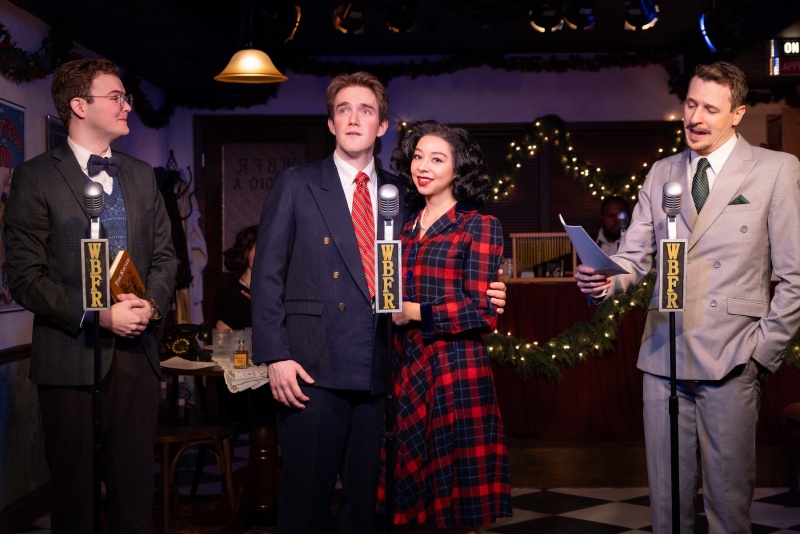
(L to R) Baxter Konstans, Ethan Smith, India Huy and Chase Wheaton-Werle in IT’S A WONDERFUL LIFE: A LIVE RADIO PLAY, from Oil Lamp Theater.
That small quibble aside, It's a Wonderful Life: A Live Radio Play's appeal is further enhanced by a pair of audience-friendly touches that help blur the line between performers and patrons. Before the show begins, cast members mingle onstage singing Christmas carols both for and with audience members as they settle into their seats, creating an immediate sense of holiday spirit. Following intermission, the actors return to read comments, congratulations, and season’s greetings written by audience members on cards before the performance. It is a simple idea, but one that reinforces the communal spirit at the heart of both the story and the production, while giving the evening a personal touch that feels uniquely Oil Lamp. That welcoming atmosphere extends beyond the stage to Oil Lamp's cozy lounge and bar area, an inviting space to relax before the performance or during intermission.
For all the affection and goodwill generated by Oil Lamp's offering, one aspect of Landry's adaptation continues to give me pause. Anyone familiar with It's a Wonderful Life knows the pivotal Christmas Eve sequence involving the missing deposit and the investigation that follows. Landry not only has Mr. Potter retain the misplaced funds that cripple Bailey Building and Loan, but also appears to involve the bank examiner in a scheme to further entrap George. George's situation is already dire, making the additional complication feel unnecessary. More puzzlingly, it transforms what should be a dutiful, impartial public official into a willing co-conspirator, a character turn that is never subsequently explored or addressed. The moment doesn't significantly heighten the drama or deepen Potter's villainy, leaving it as one of the script's few narrative choices that feels more contrived than organic.
Whatever reservations one might have about that particular script choice, there can be little debate about the effectiveness of Oil Lamp's ensemble. Framed as a 1940s radio broadcast, the performers must not only portray the residents of Bedford Falls but also the radio actors bringing them to life, often shifting between multiple characters, voices, and accents in the span of a few moments. Recently seen as the commanding title character in City Lit Theater's Scaramouche, Ethan Smith proves equally effective here. As both Jake Laurents and George Bailey, Smith brings warmth, sincerity, and emotional gravity to the role, creating a deeply sympathetic portrait of a man struggling to reconcile his dreams with his responsibilities. Without overplaying the character's anguish or sentimentality, he finds the humanity at George's core, making him a fine choice for one of the most beloved protagonists in American storytelling.
India Huy, who also appeared in Scaramouche, brings grace and versatility to Sally Applewhite and her many supporting characters. Julia Hope Budd, recently seen in Paramount Theatre's Mean Girls, contributes greatly to the play's easygoing chemistry as Lana Sherwood. She also earns several of the evening's biggest laughs through her various characterizations, particularly her playful and flirtatious turn as Violet, which she delivers with confidence and personality.
Chase Wheaton-Werle, recently seen in Midsommer Flight's As You Like It, is especially entertaining as Freddie Filmore, the company's leading radio personality and one of the driving forces behind the broadcast. Possessing an effortless charisma and sharp comic timing, Wheaton-Werle keeps the proceedings lively while seamlessly inhabiting a variety of supporting roles, each distinct in voice and personality. His ability to balance humor with the fast-paced demands of the format makes him one of the evening's most engaging presences. Baxter Konstans likewise does fine work as Harry "Jazzbo" Haywood, confidently navigating the show's many character transformations while helping maintain the illusion of a much larger company populating Bedford Falls. Anthony Augustine rounds out the ensemble admirably as the Foley Artist while also doubling as Harry Bailey, contributing strong character work and helping sustain the lively collaborative spirit that defines the company. Oil Lamp’s ensemble meets the considerable demands of Landry's format with confidence, maintaining the illusion of a bustling radio company while keeping the storytelling clear, engaging, and emotionally grounded.
There is a reason It's a Wonderful Life continues to return every holiday season in so many forms. Its message of community, sacrifice, and the impact one person can have on the lives of others remains as powerful today as it was when audiences first met George Bailey decades ago. Oil Lamp Theater honors that timeless spirit through the nostalgic framework of a 1940s radio broadcast, resulting in an evening that is equal parts heartwarming, entertaining, and emotionally rewarding. Under Becca Holloway's direction, the talented cast and creative team deliver a production rich in holiday warmth and theatrical ingenuity.
Recommended.
It's A Wonderful Life: A Live Radio Play runs through December 27 at Oil Lamp Theater in Glenview and is a delightful addition to any holiday theater outing this season. For tickets and/or more show information, click here.
Satire With a Sword: City Lit’s Spirited New Musical 'Scaramouche'

City Lit Theatre is currently bringing the swordplay world of Scaramouche to vivid life, offering audiences a rare chance to experience this spirited tale of wit, rebellion, and theatrical daring onstage. With its blend of political intrigue, romance, and commedia‑dell’arte flair, City Lit’s production captures the adventurous sweep of the story while showcasing the company’s signature literary focus. It’s a lively, sharply drawn staging that reintroduces a classic hero to modern audiences with style and verve.
Scaramouche tells the story of André‑Louis Moreau, a quick‑witted young lawyer in pre‑Revolutionary France whose life is shattered when his closest friend is killed in a duel by an untouchable aristocrat. Forced into hiding, André‑Louis slips into a traveling commedia dell’arte troupe as an out‑of‑work actor, where - thanks to the help of Pierre Binet, who immediately takes a liking to him - he quickly rises to lead the company. Donning the mask of Scaramouche, the nimble, sharp‑tongued clown whose satire cuts deeper than any blade, he begins crafting and performing daring political farces that transform him from fugitive to folk hero. His journey winds through romance, duels, disguises, and the rising tide of revolution, all while he uncovers long‑buried truths about his own identity.
Though the story is best known from Rafael Sabatini’s 1921 novel, its most significant early-stage incarnation came through Jean Sibelius’s ballet‑pantomime Scaramouche, written between 1912 and 1913. Sibelius’s adaptation brought the mischievous commedia figure to life through music and movement rather than spoken dialogue, emphasizing the character’s blend of humor, danger, and political bite. The work premiered on May 12, 1922, at the Royal Danish Theatre in Copenhagen, marking the first major performance of Scaramouche as a fully staged ensemble-shaped piece.
A century later, City Lit Theatre’s stage version captures the heart of the tale with clarity and affection, leaning into the story’s text‑centered expressiveness, wit, and emotional undercurrents rather than its spectacle. True to the company’s long‑standing mission of elevating literary works for the stage, City Lit approaches Scaramouche with a storyteller’s precision - honoring Sabatini’s narrative sweep while foregrounding the character‑driven humor and humanity that make the piece endure. Their production bridges the novel’s adventurous spirit and Sibelius’s expressive theatricality, reminding audiences why Scaramouche remains one of literature and theatre’s most enduring trickster heroes - “born with the gift of laughter and a sense that the world was mad,” and destined to turn both into his greatest weapons.
City Lit’s Scaramouche marks a genuine world premiere as a full musical, and what’s remarkable is just how naturally the saga takes to the form. Though Sabatini’s tale has lived for a century in novels, films, plays, and even Sibelius’s ballet pantomime, it has never before been realized as a traditional book musical with a sung score. City Lit recognized that the story’s imaginative DNA - its commedia dell’arte roots, its heightened characters, its blend of satire, romance, and political danger - was already begging for musical expression. That insight became the foundation for this adaptation, with music and lyrics by City Lit Artistic Associate Kingsley Day and book by Day and James Glossman, shaping André Louis’s journey with straightforwardness, wit, and story-forward verve. The result is a surprisingly seamless transformation, one that feels less like an experiment and more like the form the adventure had been waiting for.
What truly sells the concept is the sheer musical ambition of the production. With 30 musical numbers, the show fully commits to musical theatre, using songs to heighten character, hone satire, and propel André‑Louis from out‑of‑work actor to revolutionary folk hero. And the cast meets that challenge with uniformly excellent vocal performances. Ensemble members shift effortlessly between comedic patter, heartfelt ballads, and rousing ensemble pieces, giving the score a richness and variety that continually surprises. The vocal work is strong, expressive, character‑driven, and emotionally grounded, the kind of singing that makes the musical form feel not only justified but essential. City Lit’s gamble pays off: Scaramouche thrives as a musical.

Ethan Smith and Laura Michele Erle in CIty Lit Theatre's Scaramouche.
Ethan Smith anchors Scaramouche with a performance that is as nimble as it is commanding, capturing André‑Louis Moreau’s evolution from wounded idealist to razor‑sharp revolutionary with remarkable definition and charisma. Smith moves through the character’s many transformations - lawyer, fugitive, actor, firebrand - with an ease that makes the journey feel inevitable, even thrilling. His wit lands on point, his emotional beats resonate, and he carries the production with the kind of presence that makes it impossible to look anywhere else. It’s a standout turn that gives the tale its pulse.
Henry Michael Odum brings rich texture to each of the Manager/Gavrillac/Pierre Binet, shifting between roles with a grounded authority that deepens the world around André‑Louis. Laura Michele Erle offers a luminous, heartfelt Aline, playing her with a sincerity that makes her scenes glow. She balances innocence with quiet resolve, giving Aline a sense of inner life that elevates every moment she’s onstage. Conor Ripperger’s Phillipe (among other characters) is equally compelling - earnest, principled, and deeply sympathetic. His early scenes with Smith establish the emotional stakes of the structural arc, and Ripperger’s performance makes Phillipe’s fate feel genuinely affecting. Kent Joseph delivers a taut, formidable De La Tour, embodying the character’s aristocratic menace with razor precision and a chilling sense of entitlement.
The supporting ensemble adds color, humor, and texture throughout. Alicia Berneche brings elegance and sly intelligence to Madame de Sautron (and how she can sing!), shaping each moment with a knowing touch. Shea Lee’s Columbine sparkles with playful charm, her physicality and timing giving the commedia sequences real lift. Ed Rutherford makes Chapelier delightfully sharp‑edged, grounding the satire with controlled delivery. India Huy’s Climene is vibrant and expressive, adding a burst of stage-driven flair whenever she steps into the spotlight. Rushil Byatnal rounds out the troupe with a wonderfully nimble Pierrot, blending innocence and mischief in a way that feels perfectly tuned to the world of the play.
Together, this ensemble creates a dynamic, fully inhabited world - one where satire, romance, and revolution collide with irresistible spirit of invention.
Beth Wolf, a two‑time Jeff nominee, leads the production with a deft, imaginative hand, weaving together its comedy, romance, and revolutionary spirit with remarkable ease. Her direction gives the piece a vibrant pulse that carries through every scene.
City Lit Theatre has spent the past several seasons reaffirming its reputation as Chicago’s home for smart, text‑centered storytelling, offering audiences everything from tightly rendered literary adaptations to rediscovered gems that rarely see the stage. Their recent productions have leaned into that mission with renewed confidence, showcasing the company’s knack for transforming complex narratives into intimate, actor‑driven theatre. In that context, Scaramouche feels like an inspired and perfectly aligned choice - a swashbuckling tale rooted in literature, rich with political intrigue, theatricality, and character depth. It gives City Lit the chance to flex its strengths: crisp ensemble work, narrative coherence, and a love of stories that balance adventure with ideas. As part of their ongoing commitment to bringing literary worlds to life, Scaramouche fits not just well, but exceptionally well.
City Lit’s production is elevated by a design team working in striking harmony to evoke the texture and artistic boldness of late‑18th‑century France. Jennifer Mohr’s costumes - supported by her expertise as a commedia consultant - bring a vivid blend of historical detail and playful character expression, while Meg X. McGrath’s props add tactile richness to every corner of the stage. Jackson Mikkelsen’s lighting sculpts the world with warmth and shadow, shifting effortlessly between intimate moments and broader swashes of adventure. Scenic designer Trevor Dotson provides a flexible, purpose‑built environment that lets the action unfold with clarity and momentum, and Music Director Kevin Zhou does an impressive amount with a limited‑sized band. Maureen Yasko’s violence and intimacy design adds yet another essential layer, shaping moments of danger and vulnerability with precision, safety, and emotional truth. Together, they craft a world that feels cohesive, imaginative, and wonderfully alive.
City Lit’s Scaramouche is an easy production to recommend - a smart, spirited world‑premiere musical that embraces the adventure, satire, and dramatic flair of Sabatini’s plotline with real imagination. The company’s intimate Edgewater home adds to the charm, though audiences should know that parking in the neighborhood can be challenging, especially on weekend evenings. The theatre itself is located on the second floor of the Edgewater Presbyterian Church and is fully ADA accessible via elevator, making the space welcoming to all. For anyone who loves literary adaptations, new musicals, or simply a night of inventive storytelling, Scaramouche is absolutely worth the trip.
For tickets and/or more show information, click here.
This review is proudly shared with our friends at www.TheatreInChicago.com.
It'll Cast Its Spell On You: Godspell spreads the good word at The North Shore Center for the Performing Arts

There’s an old adage that says something along the lines of “don’t judge a book by its cover.” The same wisdom can most certainly be applied to playbills. More often than not the title of a musical describes exactly what the theatre piece will be about; Hamilton is about Alexander Hamilton, Annie is about an orphan girl named Annie, Wicked is about, you guessed it, a wicked witch. Following this same logic you think I’d have known what Godspell would be about prior to seeing the show. But I, ironically, judged incorrectly and found myself judged. Having heard the name in musical theatre circles and knowing it was a Broadway darling for years, I was genuinely surprised to find that Godspell was not some spooky musical about casting spells or witchcraft and wizardry but a musical based upon the gospel according to St. Matthew. Boy did I judge that book by its cover.

Godspell is a musical based on the Gospel of Matthew, which tells the story of Jesus through a modern-day group of non-Biblical characters symbolizing his "disciples" who enact his parables through song, dance, and comedy. This production of Godspell finds a fractured and disconnected community gathered at a local coffee shop discovering the transformative power of forgiveness and embracing radical love.

Like any theatrical experience patrons must have a willing suspension of disbelief. There is a burden to check all preconceived biases at the door and allow themselves to be immersed into another world for a few short hours. That’s where the magic of theatre resides, with oneself. For the first act of Godspell, I regrettably did not suspend my disbelief. I found myself resistant to the words, given they were word for word from the Gospel of Matthew. Bearing in mind I had not researched the play nor even studied the synopsis, merely checking off the show from my musical theatre bucket list, I went into the theatre not knowing anything about this play. Two songs in and I found myself not in a cushioned theatre seat but in a hardbacked pew, wondering how everyone around me was smiling and laughing while I sat questioning what was going on and pointing out hypocrisies and double-standards. Godspell is nearly word-for-word the gospels and include infectious pop and rock songs like “Day by Day,” “Prepare Ye the Way of the Lord,” “O Bless the Lord My Soul” that one might hear in any new age church. I felt myself rejecting the play, the words that were being said, the songs that were being sung, even wondering how so many people in the audience knew the play word-for-word, bar-for-bar. Surely this is just propaganda? Surely this is some kind of joke. But then it hit me. I’m being critical in the worst way. I’m judging this book by its cover. I allowed my preconceived biases to blind me of the possibility of a great show. I quickly cast away my disbelief.

Godspell was phenomenal. Debuting in 1970 with music and lyrics by Stephen Schwartz, the musical has been a consistent success, even becoming a major motion picture staring Victor Garber as Jesus. Music Theater Works’ version, directed by Matthew Silar, choreographed by Amanda Hope and music directed by Justin Kono, modernizes the play in a way that is not pandering or patronizing. Rather it weaves the play’s central theme and message with real people, quick witted humor, exceptional improv, and genuine love and care. While the context of the play can be preachy and heavy handed, as the Bible tends to be, this production is surprisingly light thanks to local Chicago talent like Jacob Simon as John the Baptist, Tafadzwa Diener, Dani Pike, and Ben Woods as the café community members. The intentional care and lightness the cast bring to their performances make you forget you’re listening to preachy gospel. You’re not being preached to, rather, you’re following skeptical and reluctant patrons find meaning in the words spoken at the open mic night by Jesus himself, exceptionally played by Eldon Warner-Soriano, and experiencing the lessons through clever and well-timed improv. Coupled with the talented cast, Silar’s version of Godspell strips away the heavy handedness, allowing the cast of characters to be their goofy-sometimes-awkward-yet-no-less-hilarious selves while still delivering impactful messages about loving your neighbor and forgiving others as you would want to be forgiven. It’s clear the cast and crew checked any preconceived biases at the door when staging this musical. Were one to have no prior knowledge of the Bible, the gospels, or religion itself, they’d find themselves immersed in a world of good words and teachings of love and acceptance one could find in dozens of books from Harry Potter to The Song of Achilles.

In today’s political and cultural climate, Godspell is a risky choice to put on. It was easy to allow that thin magical line between the real world and theatre to blur. It was easy to bring the real world with me when I ventured into the theatre. It was even easier to be stubborn and reject something simply because I don’t like how some people interpret, use, or weaponize the gospels. Personally, I think those very same people would do well to suspend their biases and see Godspell and be reminded about the true meaning and purpose of the very book they preach about. That being said, I think putting on Godspell in today’s political and cultural climate is not only important, it’s essential. The content of the play and Silar’s beautiful production will no doubt being necessary dialogue and spark conversation and ask audience members to reflect on the play vs. their defined ideals. Godspell is just a story of a man, told through the eyes of another man, and performed by exceptionally talented individuals. Or is it something more? Was this play preachy or did it have some real-life lessons and messages to take away? Do I reject the play or do I reject how others interpret the context behind the play? Am I being critical or skeptical? Hypocritical even? Hell, soon we’ll all be flocking to theatres to see a cinematic production about a wicked witch and will probably have very little issue suspending our disbelief as we watch a witch flying on a magical broomstick with her army of flying monkeys. So I implore everyone to keep that same energy when viewing this production of Godspell. At the end of the day, it’s just a show, and gods know we can all use a bit more magic in our lives, even if it limited to the theatre.
Godspell is presented by Music Theater Works and is sponsored by the Whirled Peas Foundation and presented in partnership with Curt’s Café. It is playing now through November 16th at The North Shore Center for the Performing Arts in Skokie (9501 Skokie Blvd, Skokie). Tickets are now on sale from $19.50 to $106 with tickets for guests 25 years old and younger available at half-price at MusicTheaterWorks.com or by calling the Music Theater Works box office at the North Shore Center, 847.673.6300.





Latest Articles
-
 Audiences Will Fall in Love with Northlight's All the World
Written by Angelo CamposWhen two actors share the stage show after show, how long can they keep their real feelings from stealing the spotlight? Lauren Gunderson’s All the World opened at Northlight Theatre with splendid, perceptive theatricality, as it follows two performers whose…
-
 It's a Wonderful Life: A Live Radio Play Remains a Holiday Treasure at Oil Lamp Theater
Written by Ken PayneThis holiday season, Oil Lamp Theater continues one of its most cherished traditions with the 13th annual production of It's a Wonderful Life: A Live Radio Play. A unique hallmark of the company's seasonal offering is its rotating roster of…
-
 CELESTIA: A Heavenly Event
Written by Mary Beth EukerIn 1871 our broad city burned in the Great Chicago Fire. In 1875 St. Vincent de Paul church rose in Lincoln Park. It was constructed of Indiana limestone and still stands proudly at the corner of Webster and Sheffield like…
-
Paramount's A Christmas Carol Stands Among the Season's Finest Gifts
Written by Ken PayneFew holiday stories are as deeply woven into the fabric of the season as A Christmas Carol, yet Paramount Theatre's lavish production in Aurora finds fresh magic within Charles Dickens' familiar classic. Combining spectacular stagecraft, heartfelt performances, and an infectious…
Does your theatre company want to connect with Buzz Center Stage or would you like to reach out and say "hello"? Message us through facebook or shoot us an email at This email address is being protected from spambots. You need JavaScript enabled to view it..
*This disclaimer informs readers that the views, thoughts, and opinions expressed in the text belong solely to the author, and not necessarily to Buzz Center Stage. Buzz Center Stage is a non-profit, volunteer-based platform that enables, and encourages, staff members to post their own honest thoughts on a particular production.