
Displaying items by tag: Amanda Walker
Genuine Heart Meets Classic Charm in Drury Lane’s Sunny Holiday Revival of Annie
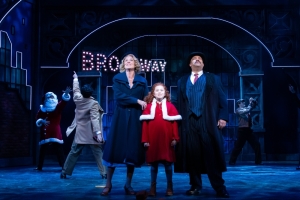
Almost fifty years after she first sang her way into Broadway history, the sun is still shining bright in Oakbrook Terrace as Drury Lane Theatre brings the beloved holiday classic Annie back to its stage for the first time in over a decade. Directed by Scott Weinstein and starring young powerhouse Emerson Mae Chan in the title role on opening night (with Catharina Araujo playing the part at select performances and Kate in others), this lavish seasonal revival captures all the Depression-era charm and infectious optimism of the original 1977 hit. From the opening notes of the overture, Drury Lane delivers a polished, crowd-pleasing take on a familiar favorite.
The story never gets old and remains a warm tale of resilience and hope. Set in New York City during December 1933, Annie follows an irrepressibly optimistic 11-year-old streetwise orphan determined to find the birth parents who left her on the steps of the New York City Municipal Orphanage a decade earlier. Armed with only half of a silver locket and a handwritten note promising they would return for her, Annie endures the daily misery of the orphanage’s bitter, scheming matron, Miss Hannigan. But her luck takes a dramatic turn when Grace Farrell, the warmhearted personal secretary to billionaire industrialist Oliver Warbucks, selects Annie to spend the Christmas holidays at Warbucks' Fifth Avenue mansion. Though initially awkward around children, the gruff tycoon is quickly charmed by Annie's pluck and determination, growing so fond of her that he asks to adopt her himself. When Annie gently declines - still holding out hope of finding her real parents - Warbucks vows to help her search, eventually offering a massive cash reward, and enlisting some help from none other than President Franklin D. Roosevelt. Predictably, the promise of a payout attracts the greed of Miss Hannigan, her swindler brother Rooster, and his accomplice Lily St. Regis, sparking a frantic race for Warbucks to expose their con and give Annie a true home just in time for Christmas.
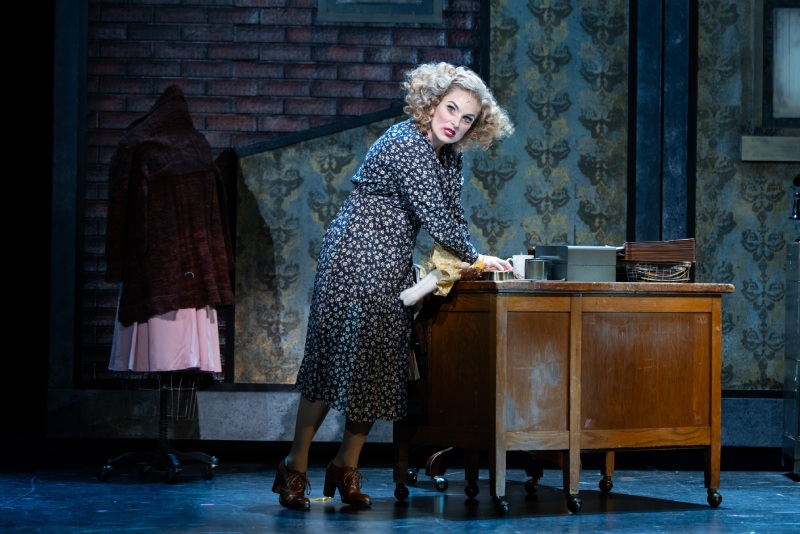
Kelly Felthous as Miss Hannigan in Annie at Drury Lane Theatre. Photos by Justin Barbin.
Weinstein’s direction keeps that familiar plot moving at a brisk, buoyant pace, anchored by standout performances across the board. After two years of touring full-time, Emerson Mae Chan returns home in her Drury Lane debut, capturing Annie’s spunky spirit with effortless charm, hitting her funniest lines with great timing and delivering a nice vocal highlight on “Tomorrow” - the signature number that defines Annie’s sunny outlook. Anand Nagraj delivers one of my favorite performances of the evening as Oliver “Daddy” Warbucks, impressing with both his strong baritone vocals and his nuanced acting. Rather than playing the billionaire as a one-note caricature, Nagraj brings genuine warmth and subtle humor to the role, making it a treat to watch his guarded exterior soften as his heart fills with love and he finds his childlike joy again. Meanwhile, nobody commands the stage quite like Kelly Felthous as Miss Hannigan, who delivers a gloriously unhinged, standout comedic performance from her very first entrance. She makes the iconic villainess unmistakably her own. Felthous is joined by Jackson Evans (Rooster) and Amanda Walker (Lily St. Regis), who each score solid laughs in their roles and help turn “Easy Street” into a high-energy highlight. Elsewhere, Allison Sill impresses vocally as Grace Farrell, lending a calming, assured presence whenever she steps onstage.
A large, energetic ensemble gives the entire production an undeniable lift. The young performers portraying the orphans often take center stage with sharp timing and genuine personality, holding their own alongside a hard-working adult ensemble that fills out the show's many worlds - stepping into everything from street vendors and radio performers to servants and politicians with ease.
Equally irresistible is Georgie, the real live dog playing Annie’s loyal companion, Sandy. Well-behaved and utterly endearing onstage, Georgie melts the theater on contact - every appearance triggers a chorus of affectionate "awwws" from the audience.
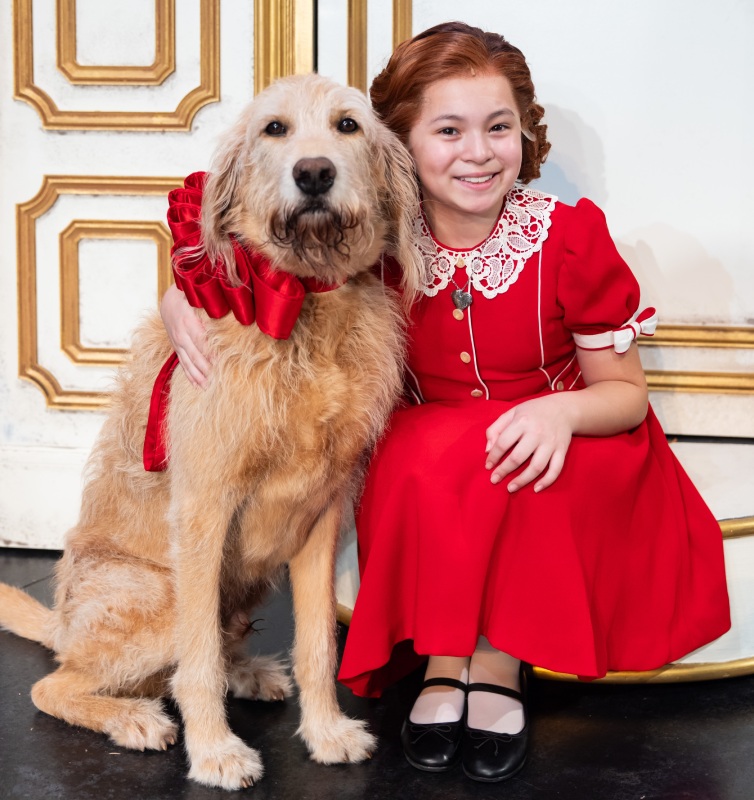
Georgie as Sandy and Emerson Mae Chan as Annie in Annie.
One of my favorite moments in the show arrives in Act II during a trip to the White House, where Annie interrupts a tense, pessimistic meeting between President Roosevelt (wonderfully played by Ron E. Rains) and his Cabinet as they struggle to pull the country out of the Great Depression. While his advisors bicker over grim economic forecasts, FDR turns to Annie for her perspective, sparking a playful back-and-forth that perfectly captures her ability to find a silver lining in everything. Sharing her simple philosophy that the sun will always come out tomorrow, Annie wins over the President - who nudges his gloomy Cabinet members to take her advice to heart before joining her in a spirited reprise of "Tomorrow" that turns a dreary policy session into a lively sing-along.
Another standout sequence was the live radio broadcast scene, which offers a fun glimpse back in time at how an old-school radio show operated - complete with a scene-stealing foley operator whose deadpan, almost-bored demeanor suggested every sound effect was pure second nature.
Visually, the production strikes a rich, theatrical balance. Under the crisp musical direction of Julia Schade, the live orchestra brings Charles Strouse’s definitive score vibrantly to life. Tijana Bjelajac’s scenic design effortlessly transitions between the bleak, shadowy grays of 1930s Hoovervilles and the warm, gilded grandeur of the Warbucks estate. Paired with Mara Blumenfeld’s period-authentic costumes and Jose Santiago’s atmospheric lighting, the staging highlights the stark economic contrasts of the era while keeping the holiday magic front and center. Mara Newberry Greer’s crisp, athletic choreography gives the young performers plenty of room to shine, particularly during high-energy numbers like "It’s the Hard-Knock Life" and "You’re Never Fully Dressed Without a Smile."
Ultimately, Drury Lane’s Annie succeeds because it treats its classic material with genuine affection rather than mere nostalgia. By pairing strong performances and polished stagecraft with an honest, heartfelt approach to the story, the production reminds audiences why this scrappy orphan has endured for nearly half a century without ever feeling dated or overly saccharine. Running at Drury Lane Theatre in Oakbrook Terrace through January 10, this joyous revival makes for the perfect holiday treat for the entire family.
Recommended.
For tickets and/or more show information, click here.
Marriott’s Heartbreak Hotel: The Rise, the Rebirth, the Return

Marriott Theatre’s Heartbreak Hotel takes on the tricky task of charting Elvis Presley’s early ascent, walking the line between the mythic figure we think we know and the unpolished young man still figuring out who he was becoming. What emerges is a brisk, music‑driven portrait that leans into the volatility of those formative years - the industry pressures that boxed him in, the personal crossroads that pushed him forward, and the creative sparks that hinted at the cultural earthquake to come. It’s a show less interested in polishing the legend than in capturing the restless drive of a talent on the verge of rewriting American music.
Heartbreak Hotel traces Elvis Presley’s early rise with a pace that stays brisk without ever feeling hurried, using a clever device: a ’68 Comeback‑era Elvis looking back on his younger selves. At times the man, the teen, and the 11‑year‑old boy share the stage simultaneously - singing, reminiscing, harmonizing - embodying a life moving faster than any one version of him can fully grasp. The musical follows Elvis from the tentative spark of his Sun Studio sessions into the glare of national attention, tracing how each new opportunity brings both momentum and complication. Producers, handlers, and well‑meaning advisors orbit him constantly, each with a different vision of who he should become, and the show uses those interactions to underline just how precarious his initial ascent really was.
As the demands of fame tighten around him, the story frames Elvis’s evolution as a series of choices - some instinctive, some imposed, all shaping the performer he’s still learning to be. Rather than digging for psychological depth, the plot focuses on the push‑and‑pull between artistic hunger and commercial pressure, capturing the uneasy transition from raw talent to cultural commodity. It’s a portrait of a young man standing at the edge of a seismic career, long before the iconography calcifies and the legend overtakes the life.
At the center of Heartbreak Hotel is Tyler Hanes playing Elvis Presley, who carries the show with a mix of youthful swagger and genuine vulnerability. His performance hinges not just on vocal accuracy but on capturing the restless, slightly bewildered energy of a young man being swept into stardom. His renditions of “Blue Suede Shoes” and “Heartbreak Hotel” land with the right mix of polish and rawness, and his quieter moments - particularly the early Sun Studio sequences and those paired with Priscilla - give the production its emotional grounding.
The show’s Colonel Tom Parker, portrayed by Rob Lindley, is the necessary counterweight: charming, calculating, and always two steps ahead. Lindley brings a slick, almost Vaudevillian charisma that keeps the character from slipping into caricature (although Parker may have been a caricature of himself anyway). His scenes pop with tension, especially in numbers where he orchestrates Elvis’s next move with a smile that never quite reaches his eyes.

Tyler Hanes as Elvis Presley (center) with ensemble in Heartbreak Hotel at Marriott Theatre.
The Sun Studio ensemble - the musicians, producers, and collaborators - provide some of the production’s most engaging textures. Jackson Evans, as Sam Phillips, is heavily featured in the first act and delivers one of the show’s standout performances, offering a steady, clear‑eyed presence that anchors the opening chapters with real artistic purpose. The play digs into Phillips’s instinct for raw talent - his uncanny ability to spot greatness beforehand - and makes clear that his relentless championing of Elvis is what first carried the young singer’s sound across Memphis and into the broader South. His work with the band digs deep and gives us an idea of Phillips’s impact in shaping a new kind of rock ‘n’ roll sound. Their group numbers in the studio, including “That’s All Right,” have an infectious looseness that contrasts sharply with the more commercialized performances later in the show.
The supporting cast adds essential color. Colton Sims offers a sharp, unaffected turn as Teen Elvis, capturing the raw spark before the polish sets in, and Charles Adler Bischoof, as young Elvis, brings a bright, unguarded innocence that reminds the audience just how early the legend began.
Elizabeth Telford lends Gladys Presley a quiet emotional weight, centering the story whenever she’s onstage. Anna Louise Bramlett brings an earnest warmth to Dixie, while Amanda Walker gives Priscilla a steady, grounded presence that subtly deepens the story.
In one of Heartbreak’s most exciting moments, Alexandra Palkovic takes control of the stage delivering a sleek, charismatic jolt as Ann-Margret, hinting at the whirlwind to come. Palkovic dances with real fire, echoing Ann‑Margret’s signature style with crisp precision and an infectious burst of energy. Palkovic later joins Hanes in one of the most touching moments when the two perform a beautiful rendition together of “You’re the Boss.” The addition of a full Ann‑Margret song‑and‑dance number feels especially meaningful, since her on‑screen chemistry with Elvis has always struck me as one of the high points of his physical and emotional vitality.

Tyler Hanes as Elvis Presley and Alexandra Palkovic as Ann-Margret.
Karl Hamilton gives Vernon Presley a quiet, understated presence, and Naiqui Macabroad stands out in his multi‑role track - Johnny Bragg, Chuck, Jackie Brenston, and the producer for both Steve Allen and Ed Sullivan - slipping between characters with crisp versatility and welcome bursts of personality. Fredrick Webb Jr. also makes a strong impression in multiple roles, notably as Roy Brown, Otis Redding, Fats Domino, and throughout the ensemble.
Going back to the musicians, the live band is one of the show’s more memorable assets. With Jake Busse as Bill Black, Zac Richey as Scotty Moore, and Trevor Lindley Craft as Ronnie (pre-DJ Fontana days) forming the tight onstage trio, the musicians anchor the production with a sound that feels both authentic and freshly charged. Lindley Craft doubles as Frank Sinatra. He and Hanes deliver one of the evening’s highlights as they recreate the famous duet from Elvis’s post‑Army appearance on The Frank Sinatra Show - a stylish medley of “Love Me Tender” and “Witchcraft” that lands with effortless charm.
Melanie Brezil also brings a radiant spark to Sister Rosetta Tharpe, delivering her featured moment with bright, joyful command on both vocals and guitar.
Together, the band’s instrumental work and the ensemble’s rich harmonies elevate the musical landscape. A mid‑show gospel sequence of “Peace in the Valley” – another one of this staging’s big moments - showcases the ensemble’s vocal power and reminds the audience of the musical traditions that shaped Presley long before fame did.
Marriott’s in‑the‑round setup gives Heartbreak Hotel an expansive energy, with action unfolding on all sides. The cast’s aisle work draws the audience in, creating a surprisingly immersive sense of scale, and the smart use of media and projections amplifies that impact even further. A staging in this intimate space gives the storytelling room to gather real thrust. That quality becomes especially clear as the sequences build toward the emotional high point, when Elvis finally sheds the cookie‑cutter movie image he’d long outgrown and reclaims his artistry in the ’68 Comeback Special, reestablishing his place as the King of Rock ’n’ Roll.
I’ve always been drawn to stories orbiting Elvis Presley, and Heartbreak Hotel earns its place among them by honoring the legend without embalming him in nostalgia. Elvis wasn’t just a chart‑topper; he was a cultural accelerant, the artist who fused gospel, blues, country, and rhythm‑and‑blues into a sound that detonated across America and permanently rewired its musical DNA. His influence stretched far beyond the stage - reshaping fashion, performance style, youth identity, and the very idea of what a pop star could be. Productions like this one matter because they keep that seismic legacy in motion, passing it from one generation to the next not as a museum relic, but as a living, breathing force that still shapes the music we hear today.
When referring to rock 'n' roll, John Lennon said it himself, “Before Elvis, there was nothing.” Heartbreak Hotel echoes that sentiment.
Directed and choreographed by Deidre Goodwin, this musical bears the imprint of an artist who understands how to propel a story without letting the spectacle swallow it. Her direction shapes the evening with a steady, purposeful rhythm, keeping the focus tight even as the musical numbers expand outward. Goodwin’s fantastic choreography blends period flavor with a clean, contemporary precision, giving the show a kinetic pulse that feels both rooted in its era and alive in the present. It’s her sense of balance - between nostalgia and freshness, between narrative drive and musical release - that ultimately gives the production its lift.
Elvis devotees will find plenty to appreciate in Heartbreak Hotel, which treats the King’s formative years and artistic rebirth with genuine affection and a clear understanding of his musical legacy. But the show’s appeal stretches well beyond Presley fandom; anyone who loves American music - from gospel and blues to early rock and soul - will recognize the joy in hearing these sounds brought to life by a superbly talented cast and band. Heartbreak Hotel runs through June 2nd at Marriott Theatre and is an exciting musical experience well worth attending.
For tickets and/or more show information, click here.
This review is proudly shared with our friends at www.TheatreInChicago.com.




Latest Articles
-
 CELESTIA: A Heavenly Event
Written by Mary Beth EukerIn 1871 our broad city burned in the Great Chicago Fire. In 1875 St. Vincent de Paul church rose in Lincoln Park. It was constructed of Indiana limestone and still stands proudly at the corner of Webster and Sheffield like…
-
 Paramount's A Christmas Carol Stands Among the Season's Finest Gifts
Written by Ken PayneFew holiday stories are as deeply woven into the fabric of the season as A Christmas Carol, yet Paramount Theatre's lavish production in Aurora finds fresh magic within Charles Dickens' familiar classic. Combining spectacular stagecraft, heartfelt performances, and an infectious…
-
 Jackalope’s ‘Engines and Instruments of Flight’ Gives Wings to the Legend of Tony Kushner
Written by John AccroccoEngines and Instruments of Flight: A Fantasia in Three Acts by local playwright Calamity West is everything you’ve ever wanted to know about Angels in America but have been too afraid to ask Tony Kushner. Jackalope Theatre gives this fascinating…
-
 Steppenwolf Theatre Presents JESSIE MUELLER WITH SETH RUDETSKY – December 18 & 19
Written by Buzz Center StageSteppenwolf Theatre Company and Mark Cortale welcome back Tony Award winner Jessie Mueller (Beautiful: The Carole King Musical, Waitress) for a special holiday engagement. Catch the Broadway star live in Chicago before she heads back to New York next spring in the…
Does your theatre company want to connect with Buzz Center Stage or would you like to reach out and say "hello"? Message us through facebook or shoot us an email at This email address is being protected from spambots. You need JavaScript enabled to view it..
*This disclaimer informs readers that the views, thoughts, and opinions expressed in the text belong solely to the author, and not necessarily to Buzz Center Stage. Buzz Center Stage is a non-profit, volunteer-based platform that enables, and encourages, staff members to post their own honest thoughts on a particular production.