
Displaying items by tag: Theater Wit
THEATER UNSPEAKABLE ANNOUNCES MIME OR NOTHING, FEBRUARY 5 - 28, 2027

Theater Unspeakable is proud to announce the cast and creative team for the Midwest Premiere of Mime or Nothing, February 5 - 28, 2027 at Theater Wit, 1229 W. Belmont Ave. Mime or Nothing is written by and starring Marc Frost and directed by Jim Iorio. Previews are Friday, Feb. 5 - Saturday, Feb. 6 at 7:30 p.m. The performance schedule is Thursdays - Saturdays at 7:30 p.m. and Sundays at 2 p.m. General admission tickets are $30 with limited $15 discount tickets. Tickets go on sale now at TheaterUnspeakable.com.
Based on a true story, Mime or Nothing brings to life the extraordinary journey of Marcel Marceau—from Jewish resistance fighter to the world's most celebrated mime. Through mesmerizing physical theater, mime and storytelling, audiences follow Marceau from his daring wartime efforts to save children through silence to the creation of his iconic character, Bip, and his rise to international stardom. Behind the white face makeup lies a remarkable story of courage, loss, resilience and hope—and a man who used the power of silence to make the world a more humane place.
The show was developed in part with students of the Chicago College of Performing Arts at Roosevelt University and the MFA in Acting program at Northwestern University as well as members of Theater Unspeakable's ensemble..
The cast and creative team of Mime or Nothing includes Marc Frost (writer & actor), Jim Iorio (director); Alice da Cunha (script consultant), Matt Mason (sound composition) and Finnegan Chu (costume design).
ABOUT MARC FROST, WRITER & ACTOR
Marc Frost is an actor, deviser, educator and Chicago native who has performed and produced work in Brazil, Ireland, Spain, the USA and the UK. He created Theater Unspeakable as a platform for original works of devised, physical theater. Based in Chicago, the award-winning company has toured nationally to thousands of young audiences at venues including Lincoln Center Education (New York City, NY) and Kennedy Center (Washington, D.C.).
He also co-founded Physical Theater Festival Chicago, an international physical theater festival. Frost currently teaches various classes at Roosevelt University and with the Physical Theater Festival. He is a proud graduate of the Commercial Theatre Institute's 14-Week Training Program for Commercial Theatre Producers in New York City.
ABOUT JIM IORIO, DIRECTOR
Jim Iorio has been a nationally recognized actor for several decades on both stage and screen. New York credits include: Broadway in the Tony Award-nominated A View from the Bridge (w/ Scarlett Johansson & Liev Schreiber), Off-Broadway in A Stone Carver (opposite Dan Lauria), Kaos at the New York Theatre Workshop, directed by MacArthur Award-winner Martha Clarke and the premiere of Carson Krietzer's Flesh and the Desert at the New York Summer Play Festival. Regional work: leading roles at major theatres nationwide, including the Guthrie Theatre, Utah Shakespeare Fest., Arizona Theatre, San Jose Rep, Missouri Rep, Portland Center Stage, Geva Theatre, Asolo Theatre and many more. He has directed at the New York International Fringe Festival and received the Kennedy Center American College Theatre Festival Directing Award for his production of Tartuffe. Television/film work includes principal roles on "Grimm," "Leverage," multiple episodes of "Law & Order," "Law & Order: CI," "Law & Order: SVU," "Queens Supreme," "The Street," "Another World," "One Life to Live," "Loving," "Going the Distance" and "Petty Crimes." Playwriting work includes a new translation of Carlo Gozzi's The Raven, and powerful 90-minute adaptations of Shakespeare's Macbeth, Julius Caesar and As You Like It (all available for production).
ABOUT THEATER UNSPEAKABLE
Founded in 2010 by Marc Frost, Theater Unspeakable is a Chicago-based company creating original physical theater that blends movement, mime, clown, and ensemble storytelling. Its original touring productions have been presented in over 25 states at venues of all sizes. Drawing on the traditions of Jacques Lecoq, Theater Unspeakable embraces experimentation with form and a collaborative approach to theater making. Its productions deliver imaginative, visually dynamic experiences that entertain, surprise, and connect with audiences of all ages.
Theater Unspeakable is proud to announce the cast and creative team for the Midwest Premiere of Mime or Nothing, February 5 - 28, 2027 at Theater Wit,1229 W. Belmont Ave. Mime or Nothing written by and starring Marc Frost and directed by Jim Iorio. Previews are Friday, Feb. 5 - Saturday, Feb. 6 at 7:30 p.m. The performance schedule is Thursdays - Saturdays at 7:30 p.m. and Sundays at 2 p.m. General admission tickets are $30 with $15 limited discount tickets . Tickets on sale now at TheaterUnspeakable.com.
Dear Rhoda, a new play set at Chicago’s Dil Pickle Club, opens January 7 at Theater Wit

Dear Rhoda invites audiences into the chaotic world of 1920s Chicago, where love refuses to surrender to fear. Inspired by the letters of Chicago bookseller Jerry Nedwick, found locked in a trunk for more than 90 years, this timeless love story with live music is written by co-authors Donna Russell and David Ranney (University of Illinois Chicago Professor Emeritus) and adapted and directed by Peter Garino, Artistic Director of The Shakespeare Project of Chicago.
"This wonderful love story, locked in a trunk for more than 90 years, got a grip on both Donna and I. Two lovers, one running a bookstore in Chicago, the other locked up in a TB sanitarium, were somehow able to strengthen their love amidst the tumultuous events of the 1920s," says Ranney.
Jerry and Rhoda meet at the Dil Pickle Club, a bohemian haven for artists, radicals, and free-thinkers. Drawn together by shared ideals and an undeniable connection, their love ignites. But as a devastating disease spreads, prejudice tightens its grip, and society teeters on the brink of upheaval, will their love endure?
The production stars J.G. Smith, an ensemble member of American Blues Theatre, as Rhoda Katz, and veteran New York actor Tom Morin as Jerry Nedwick. The ensemble features Josh Carpenter, Joe Fernandez, Jenny Hoppes, Dev Kennedy, Tim Kough, Dina Monk, and Allison Sokolowski. Shawn Wallace provides live piano accompaniment.
The creative team includes Lia Wallfish (costumes), Sierra Walker (lighting), Hannah Dykstra (projection design), Naya Tadavarthy (set decoration/properties), Hannah Amell (dramaturg), and Christopher Prentice (stage manager).
Tickets and Information
Venue: Theater Wit, 1229 W. Belmont Ave., Chicago, IL 60657
Dates: January 7-24, 2027
Performance Schedule:
- Thursdays and Fridays at 7 p.m.
- Saturdays at 2 p.m. and 7 p.m.
- Sundays at 2 p.m.
- Additional performance Wednesday, January 20 at 2 p.m.
Runtime: Approximately 2 hours, including one 10-minute intermission
Tickets: $30. Groups of 10 or more save $5 per ticket. Theater Wit members attend as part of their membership.
Visit Dear Rhoda for tickets and additional information, including the historical background behind the production.
About The Shakespeare Project of Chicago
Since its founding in 1995, The Shakespeare Project of Chicago has presented more than 150 staged readings of the works of William Shakespeare and his contemporaries, performed by professional actors in public libraries and at Chicago's Newberry Library. The company's education outreach program also brings Shakespeare workshops and abridged productions to local schools.
For more information, visit The Shakespeare Project of Chicago.
About Theater Wit
As a production company, Theater Wit is dedicated to producing humorous, challenging, and intelligent plays that speak with a contemporary theatrical voice. As an institution, it serves as a hub for Chicago's neighborhood theater community.
Led by Artistic Director Jeremy Wechsler, Theater Wit hosts a variety of storefront theatre companies in its three 99-seat performance spaces, giving audiences access to a wide range of productions and artists from across the Chicago theater landscape.
Hell in a Handbag Presents IT’S A HORRIBLE LIFE – A GOLDEN GIRLS LOST EPISODES MUSICAL PARODY – December 3, 2026 – January 3, 2027 at Theater Wit

Hell in a Handbag Productions is pleased to launch its 25th Anniversary Season with the world premiere of It's a Horrible Life – A Golden Girls Lost Episodes Musical Parody, the first-ever musical installment in the company's long-running Golden Girls: The Lost Episodes parody series. Written by Artistic Director David Cerda* and directed by Ryan Kenney, It's a Horrible Life will play December 3, 2026 – January 3, 2027 at Theater Wit, 1229 W. Belmont Ave. in Chicago's Lakeview neighborhood. Single tickets are on sale here, by calling (773) 975-8150 or in person at the Theater Wit Box Office. Season subscriptions are available here.
The cast includes ensemble members Kelly Bolton*, David Cerda*, Grant Drager*, Ed Jones*, Scott Sawa* and Danne W. Taylor* with Britain Shutters and Honey West. Understudies include Nick Dorado and Gretchen Greear.
About the Production:
Following a string of holiday mishaps and a disastrous audition for the Miami Senior Center's production of It's a Wonderful Life, Dorothy (David Cerda*) begins to question her very existence. An angel intervenes, revealing that her roommates wouldn't last 20-minutes without her.
The production team includes Marcus Klein* (Scenic Designer), Ben Argenta Kress (Costume Design), Elizabeth Cooper (Lighting Design), Maggie O'Brien (Props Design), Syd Genco** (Make-Up Design), Keith Ryan* (Wig Design), Mealah Heidenreich* (Production Manager), Jason Pikscher (Technical Director), Julia Witty (Stage Manager), Max Ching (Assistant Stage Manager), Peter Neville (Videographer), Rick Aguilar* (Photography) and Michael S. Miller* (Graphics).
For a quarter-century, Handbag has served Chicago audiences its unique brand of camp and ridiculousness – earning a fiercely dedicated following and a recent induction into the 2026 Chicago LGBT+ Hall of Fame.
*Denotes Handbag Ensemble Member | **Denotes Handbag Associate Member
PRODUCTION DETAILS:
Title: It's a Horrible Life – A Golden Girls Lost Episodes Musical Parody
Playwright: Artistic Director David Cerda*
Director: Ryan Kenney
Cast (in alphabetical order): Kelly Bolton* (Sophia), David Cerda* (Dorothy), Grant Drager* (Blanche), Ed Jones* (Rose), Scott Sawa* (Stan), Britain Shutters (Mary), Danne W. Taylor* (Nancy Drew) and Honey West (Angel).
Understudies: Nick Dorado and Gretchen Greear.
Location: Theater Wit, 1229 W. Belmont Ave., Chicago
Previews: Thursday, December 3 at 7:30 pm, Friday, December 4 at 7:30 pm and Saturday, December 5 at 7:30 pm.
Opening performance: Sunday, December 6, 2026 at 7 pm
Regular run: Thursday, December 10, 2026 – Sunday, January 3, 2027
Curtain Times: Thursdays, Fridays and Saturday at 7:30 pm; Sundays at 3 pm. Please note: there will not be performances on Thursday, December 24 (Christmas Eve), Friday, December 25 (Christmas Day), Thursday, December 31 (New Year's Eve) or Friday, January 1 (New Year's Day); there will be added performances Tuesday, December 22 at 7:30 pm, Wednesday, December 23 at 7:30 pm, Tuesday. December 29 at 7:30 pm and Wednesday, December 30 at 7:30 pm.
Tickets: Previews: $32 general admission, $40 VIP reserved seating (includes a drink). Regular run: $42 general admission, $54 VIP reserved seating (includes a drink). $35 seniors. Single tickets are on sale here, by calling (773) 975-8150 or in person at the Theater Wit Box Office. Season subscriptions are available here.
About the Artists
David Cerda (Playwright) is a founding member and Artistic Director of Hell in a Handbag Productions, now celebrating its 25th anniversary. As resident playwright, he has written many Handbag productions, as well as acted in them. These works include POSEIDON! An Upside-Down Musical, The Birds, Scary Town, SCARRIE The Musical, Rudolph the Red-Hosed Reindeer, Joan Crawford Goes to Hell, Caged Dames, and many others. His play, The Drag Seed was produced at LaMaMa Experimental Theater and his Golden Girls Lost Episodes parody shows have been produced around the country and featured in Golden Con: Thank you for being a Fan, the world's first fan convention dedicated to all things Golden Girls at Chicago's Navy Pier. Cerda is a proud inductee into the Chicago LGBT Hall of Fame and recipient of a Jeff Award for lifetime achievement for his body of work and service to the community. He lives in Chicago with his partner, Christopher and Walter the Wonder Dog.
Ryan Kenney (Director) is a Chicago-based multi-hyphenate. Previous Hell in a Handbag credits include; Joan Crawford Goes to Hell and The Real Housewives of the North Pole. Additional directing credits include Effing It Up (Fat Theatre Project), Aunt Dan & Lemon, The Turn of the Screw, Phèdre, and Cain: A Mystery, all for 2W Holdings and Theatrics, LLC for which he is the Executive Director. As an actor, Ryan has performed in Three Sisters (Sandbox Theatre Collective), Vivi Mortes Motel (Green Shirt Studio), Machinal (Meat Machine) and Whiteᐧish: A Sketch Revue (The Second City), and created and performed his solo show Ryan Kenney's Edward Albee's Who's Afraid of Virginia Woolf (former Playhouse Theater).
About Hell in a Handbag Productions
Hell in a Handbag is dedicated to the preservation, exploration, and celebration of works ingrained in the realm of popular culture via theatrical productions through parody, music and homage. Handbag is a 501(c)(3) Not for Profit. For additional information, visit handbagproductions.org.
Remy Bumppo’s Mud Row: A Family Haunted by the Past
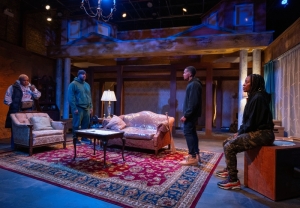
Remy Bumppo opens its 30th anniversary season with Mud Row, a play by Tony Award nominee and MacArthur “Genius” Grant recipient Dominique Morisseau. Expertly directed by Malkia Stampley, this production is a sublime examination of family, inheritance, and the difficult choices that determine what we pass on to the next generation.
Set in Mud Row, a historically Black neighborhood in West Chester, Pennsylvania, the play moves between the early 1960s, during the Civil Rights era, and the contemporary period. The earlier scenes follow sisters Elsie (Alexis Janae) and Frances (Toccara Castleman) as they navigate young adulthood, unaware that the decisions they make will reverberate through generations. In the present-day scenes, granddaughters, Regine (Ayanna Bria Bakari) and Toshi (Tiffany Renee Johnson), must confront the family legacy they have inherited.
Stampley has created a living family album, particularly in the scenes set in the 1960s. We watch Elsie and Frances move through their lives with the innocence of people who cannot yet see the long shadow their choices will cast. They are carrying wounds of their own, shaped by the circumstances in which they grew up. Without necessarily recognizing it, they risk passing that trauma to Elsie's unborn child and, eventually, to their grandchildren.
Morisseau's central question is both intimate and universal: What do we do with the past? Do we escape it, hoping that distance will free us from its burdens, or do we reclaim it, confront its painful truths, and find a way to transform what it means?
The family home becomes the physical embodiment of that question. Scenic designer Sydney Lynne creates a house that seems to possess a life of its own. In the 1960s scenes, it feels inhabited, furnished with the details of a home where people live, argue, dream, and make plans to change the future. In the contemporary scenes, the same space can appear abandoned, almost as if the house itself is yearning for someone to return and breathe life into it.
Yet even when the house is occupied, it never feels entirely free of its ghosts. Stampley makes those unseen presences palpable through breathtaking scene changes. The transitions are more than technical accomplishments; they reinforce the sense that the past is never entirely gone. It lingers in the rooms, in the silences, and in the relationships of those who remain.
The uniformly excellent cast gives Morisseau's dialogue its necessary emotional grounding. Her writing can, in less assured hands, occasionally sound like a discussion panel, with characters articulating ideas about history, race, and family rather than simply living through their circumstances. That is not the case here. These actors make the emotional intensity feel organic. Their conflicts emerge from recognizable human needs: the desire to belong, the longing to escape, the fear of repeating a parent's mistakes, and the hope that life might offer another chance.
Jabari Khaliq as Tyriek and Jamaque Thomas as Davin contribute to the ensemble, while the performances of Janae, Castleman, Johnson, and Bakari give the family history its emotional continuity. The younger women are not simply repeating the lives of those who came before them; they are struggling to determine what their inheritance means and whether they must remain bound by it. The emotional weight of that struggle comes into sharp focus in a second-act scene between Toshi and Regine that brought me to tears.
Levi Wilkins' lighting design deepens the atmosphere, while Evelyn Danner's costumes establish the distinct periods without distracting from the characters. Christopher Kriz's original musical composition and sound design help sustain the production's sense of memory, place, and time.
Morisseau examines two generations separated by decades but connected by patterns of family behavior, unspoken pain, and the consequences of choices made long before the next generation was born. The earlier generation belongs to the Silent Generation; the contemporary characters reflect a different set of expectations and possibilities. The contrast underscores how the world changes while certain family wounds remain stubbornly familiar.
But Mud Row is not simply a lament about the persistence of trauma. Its deeper concern is whether that inheritance can be interrupted. History may explain the circumstances in which people find themselves, but it does not have to dictate every choice they make. Somewhere in the cycle, a child—or an adult who finally recognizes the pattern—must be willing to say that things can be different.
That possibility gives the play its emotional force. The past cannot be erased, and neither can the damage it leaves behind. But understanding where the pain began may be the first step toward refusing to pass it along.
With this production, Remy Bumppo offers more than a beautifully staged family drama. Mud Row becomes a house of memories, inhabited by the living and haunted by the choices of the dead. Stampley's sensitive direction and the cast's compelling performances make those ghosts feel immediate, reminding us that every family inherits a history—but no family is necessarily doomed to repeat it.
HIGHLY RECOMMENDED
When: Through Nov. 15
Where: Theater Wit 1229 W. Belmont Avenue
Tickets: $38 - $54
Adults-only holiday fun: Who's Holiday! brings R-rated Cindy-Lou Who back to Theater Wit for her sixth year, Nov. 27-Dec. 27

Christmas Day is in our grasp. Why the vodka? Glad you asked!
Who's Holiday! brings R-rated Cindy-Lou Who back to Theater Wit for her sixth consecutive year of adults-only holiday fun.
Step inside Chicago’s #1 holiday bedazzled mobile home to meet Cindy Lou-Who, now 40, as she reveals the shocking true story of all the crazy things that happened after her Christmas Eve encounter with the Grinch. Veronica Garza, who earned a Jeff nomination for originating the role in Chicago, and recently won a 2026 Jeff Award for Best Performer in a Supporting Role in Marriott Theatre’s A Little Night Music, is back as Cindy Lou-Who – funny, flirty and foul-mouthed as ever.
First Cindy-Lou welcomes audiences into her mobile home at the base of Mount Crumpit for a festive holiday party. After plying her guests with party snacks and Malort, she spills the green tea about the twisted turns her life took after her Christmas Eve encounter with the Grinch.
The Chicago Reader called Wit’s annual holiday bon bon “a hell of a lot of fun…Garza’s performance offers surprises for her audience at every nook and cranny.” “Raunchy, hilarious, and shatteringly honest, you won’t even care that a tear sneaked out," raved Third Coast Review. Chicago Theater Review wrote Who’s Holiday! is “a very funny, often poignant production guided with panache by an excellent director.”
Director Christopher Pazdernik returns to direct Wit’s sixth outing of this hilarious, heartfelt holiday comedy by Matthew Lombardo. Also back is Angela Weber Miller’s Jeff Award-winning, Seuss-inspired set. Designers include Shelley Strasser, lights; Uriel Gomez, costumes; Lonnae Hickman, props, and Matthew R. Chase, sound and production manager.
Opening Night is Friday, November 27 at 7 p.m. Performances run through December 27: Saturday, November 28 at 7 p.m.; Sunday, November 29 at 3 p.m.; Monday, November 30 at 7 p.m. (Industry Night); Thursday and Friday, December 3 and 4 at 7 p.m.; Saturday, December 5 at 3 p.m. and 7 p.m.; Sunday, December 6 at 3 p.m.; Thursday and Friday, December 10 and 11 at
7 p.m.; Saturday, December 12 at 3 p.m. and 7 p.m.; Sunday, December 13 at 3 p.m.; Thursday, December 17 at 7 p.m., Friday, December 18 at 7 p.m. and 9 p.m.; Saturday, December 19 at
7 p.m.; Sunday, December 20 at 3 p.m. and 5 p.m.; Tuesday, December 22 at 7 p.m., Wednesday, December 23 at 7 p.m.; Saturday, December 26 at 3 p.m. and 7 p.m.: and Sunday, December 27 at 3 p.m. Run time is 70 minutes, no intermission. Tickets are $42-$70. Who’s Holiday! is for adults only. Tickets for children 12 and under are $500. Purchase tickets at theaterwit.org or call the Theater Wit box office, (773) 975-8150.
Theater Wit is located at 1229 W. Belmont Ave., in Chicago’s Lakeview neighborhood. Convenient parking is available for $10 across the street in the lot behind Kubo restaurant (pay at the Theater Wit box office.) Neighborhood street parking is available, as are private paid lots (tip: book ahead and at a discount with Spothero). Theater Wit is also accessible via the CTA 77 Belmont bus, and is three blocks west of the CTA Belmont Red/Brown/Purple line stop.
To learn more, visit theaterwit.org or follow the company on Facebook and Instagram.
Chicago’s Theater Wit introduces new Watchword closed captioning system, dramatically improving access in all three of its theaters
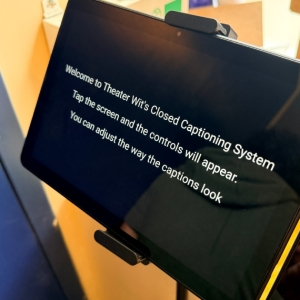
Chicago’s Theater Wit is now offering new, state-of-the-art closed captioning service, marking a dramatic improvement in making live theater more accessible for patrons who are deaf or hard of hearing.
Until now, captioning typically involved a staff person backstage, projecting the text of the script on the set, or on patrons’ cell phones, thus allowing audiences to read along in real time. Captioning is traditionally offered at select performances only, and sometimes required users to sit in a specific section of the theater.
No more. Now, at Theater Wit, patrons can engage with closed captioning at almost every regular performance, from any seat in the house, free of charge.
“This is the same state-of-the-art closed captioning system used by large touring shows like Harry Potter and the Cursed Child , but we believe we’re the first small theater in the nation to roll out fully automated closed captioning service for dozens of productions,” said Theater Artistic Director Jeremy Wechsler.
Following successful trial runs during the final weeks of Wit’s season-opening smash hit, Adolescent Salvation , the new system, called Watchword, will now be available during the regular run of all Theater Wit productions.
What’s more, Wit is making the service available for free to all of its resident and visiting companies, thereby expanding and improving traditional closed captioning in all three of its 99-seat theaters.
With Wit’s new system, the text of the play is loaded into the software as usual. The difference is Watchword actually “listens” to every live performance on stage, recognizing phonemes, or the smallest unit of sound that can change the meaning of a word. When paired with the pre-queued script, the system syncs its captions with the dialogue, lyrics and sound effects as they happen in real time, almost never losing track of what’s happening live, on stage.
Each of Wit’s three theaters now has a dedicated Watchword monitor installed, which listens to incoming audio while simultaneously watching sound and light cues. As a result, the system delivers written captions to users on a small tablet, modulating its timing at each performance to match the pace of the dialogue being spoken by the actors on stage. Best of all, it requires no human operator, making it easy to offer at every performance.
In addition to patrons who are deaf or hard of hearing, many neurodivergent people find that following text alongside audio helps them engage more fully with a performance. It’s also a valuable service for audiences who speak English as a second language.
“Patrons tested the technology the past few weeks at performances of Adolescent Salvation, and feedback was very positive,” added Wechsler. “I’m thrilled to say our resident companies Shattered Globe Theatre, with its new production, Vladimir, and Remy Bumppo’s Mud Row , are both offering Wit’s enhanced closed captioning service at regular performances starting this fall. We expect many other companies will take advantage of this technology throughout the theater season.”
Audiences who’d like to try Wit’s new free closed captioning service can do so with a click of a button while purchasing tickets online at theaterwit.org, or by calling the Theater Wit box office, (773) 975-8150. Theater Wit is located at 1229 W. Belmont Ave., in Chicago’s Lake View neighborhood.
The introduction of Wit’s new closed captioning technology is supported by a lead donation from a private individual (for more information about hearing loss visit hearingloss.org), with additional funding from The Saints. To learn more, visit theaterwit.org or follow the company on Facebook or Instagram.
Hail Mary/Maria at Theater Wit – A Welcome New Slant on Crossing Over into Adulthood
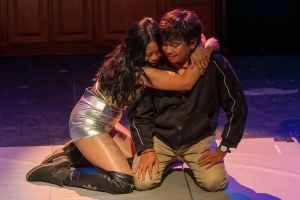
Coming of age stories resonate more profoundly when they mirror the lived reality of a real person. That’s why the firecracker of a play, Hail Mary/Maria, that’s just begun its far too short run at Theater Wit, is must-see theater for just about anybody who counts themselves as a member of the human family. If you’ve ever been young or wracked with self-doubt, Hail Mary/Maria proves there are avenues that lead to clarity and self-actualization. Making the play act as a raucous, hugely humorous and often touching guide on how to find them.
Very much a reflection of playwright RJ Silva’s own experiences, the story follows the life of Kid (Juan Sedonio), a teenager who immigrated to the US with his mother from the Philippines when he was in the seventh grade. Now in an all-boys high school, he’s a little bit of a loner and completely hooked on the exploits of his favorite pro-wrestler, Maria. He’s also, with great misgivings, about to embark on his first journey into romance.
A badass brawler with heart, it’s Maria we first meet when the play opens. She pumps up the crowd with her bravado, high voltage smile and saucy hair flips. A stark contrast with the subdued and self-enclosed Kid, Maria’s the bolt of energy that serves to ignite a story that’s about to match her spirit.
The core of the play starts innocently enough in school with Kid, which is short for Kindness, sitting alone listening to music through his earbuds. He’s joined by another student who casually strikes up a conversation. Confident and friendly, the boy is feeling Kid out, trying to learn more about him. He trips over the typical stumbling blocks when it comes to pronouncing foreign names and learning new things about a different culture. But there’s no animus. He’s open and curious. They both tap into their recall and remember being aware of each other from previous school encounters. Blond and self-assured, the new arrival’s name is Jack and it’s clear he wants to be friends. Since Jack (Aidan Leake) is really into the new Avatar movie, we can tell it’s the original he’s talking about and that the play’s setting is fifteen years or so in the past.
We can see too from their exchange that Kid, although on the surface quiet and retiring, has some spunk to him. Once he begins talking about why he’s such a fan of the wrestling phenom, Maria, played with zestful impeccability by Carina Lastimosa, we get a glimpse of his animated side. To Kid, she’s an underdog who became the top dog. An inspiration. There’s a lot of pride that comes pouring through in his admiration for her.
We meet Kid’s other role model at home. It’s his Mom, Marie (Marie Tredway). The quintessential Filipina nurse; tireless, indispensable, magnanimous, Marie’s got an iron core that’s fortified and sustained by her faith and belief in Mama Mary. A figure most of us know as the Blessed Virgin Mary. In Kid’s household, she has a shrine set up in her honor and consulted by Kid as well as his Mom for guidance and advise. Filling two roles, Lastimosa shows how easily she can portray widely divergent personalities. As Mama Mary, she beautifully personifies a potent blend of compassion and enlightened understanding when responding to Kid’s solicitations.
Scenes that take you inside Kid’s home are some of the most moving and treasured in the production. Thanks in no small part to Katelyn Montgomery’s wonderfully evocative set. They’re portals into a world rich in tradition, strongly held belief and the type of family values that insure cohesion. Attributes that on one hand are wonderfully sublime and on the other almost quaint. The types of characteristics that may have once flourished in the American culture as well; but have long since dissipated or atrophied.
Very much a collaborative effort, Hail Mary/Maria is directed by Mr. Silva’s husband, Adam Reed. The unconventionality of the central character is complemented by an equally unorthodox directorial approach in Mr. Reed’s debut directing effort. One that fills the one-act performance with heaps of emotional and physical dynamism while encouraging plenty of audience interaction.
Pro wrestling of various shades have long been extremely popular in the Philippines. From the responses of the audience Saturday night, it has a strong following in this country too. Rather than conjuring it only through the imagination, Hail Mary/Maria brings it live and center stage, giving the uninitiated a taste of its electric appeal. The ploy works beautifully, making Hail Mary/Maria as much a rewarding visceral charge as it is a splendid theatrical offering.
From that initial conversation between Kid and Jack, you somehow know Jack had more than friendship on his mind when he sat down next to Kid that day. And he likely sensed that Kid was interested in him, too. As we all know, a lot can be transmitted in a simple glance.
Kid and Jack inch their way toward understanding one another and liking each other even more as their familiarity grows. Something that triggers trepidation and even fear in Kid. How can he reconcile who he is with what he thinks should be? How that dilemma is resolved is what makes this project so appealing. There’s a wholesomeness to it that feels very honest. The solid gold cast help make Hail Mary/Maria a treasure. Both Sedonio and Leake fill their roles with the kind of intangibles that make what they present on stage memorable. A statement that’s just as true for Lastimosa and Tredway. You can’t help but want to see them all in other works that showcase their skill and gifts as well as this project one does.
The only pressing question now might be, what’s the fledgling entertainment enterprise going to roll off their runway next?
Hail Mary/Maria
Presented by Nova Entertainment
Thursday, August 20th - 7:30pm
Friday, August 21st – 7:30pm
Saturday, August 22nd - 2:30pm & 7:30pm
Sunday, August 23rd - 2:30pm
Venue: Theater Wit in Theater 2
1229 W. Belmont Avenue
Chicago, IL 60657
For more information and tickets: https://www.theaterwit.org/tickets/productions/602/performances
Highly Recommended
Funny, Incisive 'Southern Rapture' Skewers All Parties in 'Angels in America' Fracas

“Southern Rapture” quickly elicits loud guffaws from the audience, a heartening circumstancve, as it means playwright Eric Coble’s script is doing its job. Billed as a satire, it recounts the tumultuous week in real life leading up to the 1996 opening night of Tony Kushner's celebrated AIDS play, “Angels in America” in Charlotte, NC. But what might have been a tragic recount of small-minded efforts at artistic repression gets turned on its head, a potential tragedy mined for comedy, with an ending that is at once affirming and exhilarating.
This show at Theater Wit, produced by three-year-old Tin Drum Theatre Company, is loaded with broad humor, and is something of a backstage comedy as well. For purposes of the script, Charlotte becomes a generic southern city, and Kushner becomes Anton Finewitz, and his vaunted work is transformed into “Rapture in America.”
The show parodies not just the reactionary forces that sought unsuccessfully to keep “Angels in America” from the stage of a rising southern metropolis. It also takes aim at the theater company, its governing board, local government, and the national media that spun the controversy into the unnuanced, dualistic divisiveness that seems to have solidified as a way of American life today.

Andrew Bosworth as Reverend Dupree and Jenny Hoppes as Laverne Jackson protest the opening of "Rapture in America."
As “Rapture in America” barrels toward dress rehearsal, a big supratitle flashes the daily countdown to its local premiere. In an opening monolog to the audience, Marjorie Hooper proudly tells us, “The play’s won the Pulitzer, Tony, Drama Desk Award, an Evening Standard Award, the Rainbow Excellence Award and an ASPCA citation (that last one is a laugh line)—We’re one of only six theaters in the nation to get the rights to do the show outside of New York!” Indeed!
When word gets around there will be full frontal male nudity in the show, the gears of progress run unevenly, and almost grind to a halt. Company director Marjorie Winthrop (Shannon Leigh Webber) attempts to insulate her performers from the backlash, which comes in the form of Reverend Dupree (Andrew Bosworth) and a town gadfly Lavern Jackson (Jenny Hoppes). Jackson has read the script and counted the number of mentions of “cocksucker” and other notable perversions to the Charlotte Town Council. (In a content warning to the audience, Jackson’s list includes “one penis,” which indeed appears in the second act at Theatre Wit.)

Theater critic Simon Larisher (Jordon Gleaves, left) conspires to promote "Rapture in America" with production director Donald Sherman (Michael Stejskal).
Charlotte Mayor Winston Paxton (Teddy Boone), ever even-tempered, tries to stay above the fray. His aspirations for transforming this growing city into a world-class metropolis have netted a symphony orchestra, a national sports franchise, and now, an important regional theater company, about to move into the big leagues. But the mayor is beginning to feel unsettled, praising the season’s opener, "The Odd Couple," and encouraging Marjorie to do something other than “Rapture.”
“There’s still gonna be plenty of art!,” the Mayor argues. “It’s just art we can all appreciate. Because that ‘Odd Couple’ was one of the goddam funniest things I ever saw in my life.” But Marjorie will have none of that, declaring the play "epic."
It even dares to cut through the slavish devotion accorded "Angels in America" and Kushner himself, asking a if this two-part six-hour "epic" work might be too much in a town that likes to get home in time to catch Jay Leno.
"'“Epic' meaning?" asks the mayor. "Three hours, two intermissions," Marjorie tells him. "And that’s just Part I. Part II is three hours too."
"Good lord, is this a play or a telethon?" asks the mayor, and the playwright punctures the unquestioned aura that seems to envelop Kushner and his fans.
Amid the brewing ontroversey, Marjorie conjures up a “bubble” for the players, a send up of that too precious psychobabble affectation that performers may have seen once or twice:
Marjorie: We’re in the bubble, say it with me.
Players: We’re in the bubble.
Marjorie: And what do we do in the bubble?
Players: We make art in the bubble.
Even theater reviewers get skewered in the no-holds-barred script:
“When I have something to say,” says beleaguered Mayor Paxton, “I’ll talk to a real reporter.”
“I am a journalist,” Simon Larisher (Jordon Gleaves) retorts, to which the mayor replies, no, “You’re a theater critic!” Ouch! Larisher helps raise the profile of the imminent production in concert with the publicity-hungry production director Donald Sherman (Michael Stejskal).
The playwright specifies just seven actors should play the 16 roles, and director Jason Palmer and the high-caliber cast carry this off wonderfully. Casting credits go to Teddy Boone. Particularly notable is Andrew Bosworth as the protesting preacher Reverend Dupree, and two of his nemeses: the playwright who has flown from New York into the fray, and company member Mickey Steadman, who will deliver the full monty. Bosworth plays the roles distinctively and we have no confusion.
Even more so for Mary Ann Bowman as the theater company board chair, the district attorney, and the over-the-top Nyla-Jean Geisy, a winged creature essential to the play within this play. Likewise for Gleaves, who carries off very well with the support of a good script four roles, including the TV host of “Night Line” and Franklin McManus, a highly effective lawyer given to flowery South Carolina colloquialisms.
Beyond its funny rendition of what it must have been like in Charlotte in 1996, “Southern Rapture” does something more. For me, it’s a reminder that we can recover from our seemingly intractable current state of social affairs. After all, we’ve done it numerous times in the last three decades, and even following the darkest of times in the 1950s with McCarthyism and the blacklisting of creatives.
Back in the real Charlotte, “Angels in America” opened to record ticket sales, and the protests withered in the face of ticket-buyer preferences. Though the theater company that produced it saw its funding cut in retribution, a successor there commissioned this very funny “Rapture in America,” which feels cathartic all in all.
Now “Angels in America” is the stuff of celebrated revivals, and no one blinks an eye. So we do make it through these times of darkness, the forces of Steven Miller, Trad Wives and Andrew Tate notwithstanding. And we will recover from our current predicament too.
Even with some clunkers among its running gags and jokes, “Southern Rapture” is highly recommended. It runs at Theater Wit through June 28, 2026.
This review is proudly shared with our friends at www.TheatreInChicago.com.
Alone Together: Three Guys Fishing for Love in Stellar 'Eelpout!'

Shattered Globe’s world premiere of the delightful comedy “Eelpout!” delivers its punches with deceivingly understated skillfulness. Written by Paul W. Kruse, who calls it a fantasia, it is beautifully conceived and directed for the stage at Theater Wit by Jeremy Ohringer, whose “A Devil Comes To Town” at Trap Door has made me a big fan of his stage work.
“Eelpout!” examines the less frequently visited territory of the emotional relationship between two men in this tale of a stag party set in an ice fishing hut in Minnesota. We meet Ole Olsen (Carl Hallberg is terrific)—soon to marry Lena (Lydia Moss’s brief appearance is a knockout)—as he and his best buddy Sven Svensen (Jeff Rodriguez in a nuanced performance) trek across the frozen water in the pre-dawn darkness aiming to fish and drink.
Gradually we gather that Ole is more vested in the manly pursuits like ice fishing, while Sven is a more sensitive reflective soul. Their overlap, the safe area in which male intimacy is expressed, is in spectator sports, and chugging booze. Ritualistic beer and shots action is called upon whenever the conversation veers toward honest male intimacy. Likewise for a terse memetic conversation, almost totemic in its value and repeated throughout the play by multiple characters, runs like this:
You catch that game yesterday?
Nail biter.
Sure was.
Down to the buzzer.
These devices substitute for emotional connection, or defer it, for the men.
As the play opens on icy Lake Mille Lac (a real place), Sven pauses to take in the magnificent starry night and beckons Ole to join him and drink in the beauty. The language they have to express their feelings is terse, constrained by male convention, and even more so by their monosyllabic vernacular, which the playwright wields with amazing versatility. (There is a plethora of unusual nouns that I had to Google, only to find that they are real words, at least in Minnesota.)
SVEN: Ole. Just look!
OLE: Oh
SVEN: Worth it.
OLE: How about that.
SVEN: Prettiest right before the sun comes up.
Ole: Yessir
Sven tells Ole, “You ever think about how looking at the milky way is looking sideways through a pancake of stars?” Perhaps touched by the moment, Ole is moved to share a confidence with Sven: that he and Lena will name their first born after him. Now Ole is disappointed that Sven is less than enthusiastic. "You're supposed to be happy,” complains Ole. Sven deflects. “I wanna fish,” But their true feelings spill out in the course of the play, when Sven predicts to Ole that after he is married to Lena, their friendship will suffer and their offspring will take centerstage.
This conversation comes soon after Sven has an accidental dunk into a frigid spear fishing hole during the starlit walk. There he meets the magical Eelpout (Jesús Barajas is absolutely enchanting), a sentient fish in glistening red sequined body stocking. Eelpout engages Sven, nibbling at him in magical fish-like exploration. Barajas is so good in his role, both fishlike, and an alien personality almost from another dimension. It’s a remarkable performance, so good that even one of his stylish exits earned applause!
I suspect the playwright has given us an altogether new personality type - vaguely, a bit Sheldon Cooper-ish from Big Bang theory, maybe Jake Gyllenhaal in "Buzz Saw," with that dash of a very restrained yet overtly gay sensibility. Eelpout as a type seems a rare but familiar character in real life, but I don’t think I’ve seen it on a stage or film.
A third-wheel character arrives in the shape of Lars (Dina Berkeley) with gender bending affect - just one of the guys, but there’s just something you can’t put your finger on. Lars is a well-intentioned dolt and a schmuck, and also affords the playwright an opportunity to caricature the ungainly social behavior of the male suffering deep-seated insecurity and feelings of inadequacy.
In addition to the fantasia style of this play, conjuring visions of great bodies of swirling, writhing, spawning aggregations of fish, the playwright also incorporates classically funny physical comedy and comedy of errors skits: Ole and Sven in skivvies under a blanket, warding off hypothermia and trying unsuccessfully not to get hard; a mistaken identity in which not one, but two stag party strippers (Taigé Lauren as Heidi and Rebecca Jordan as Holly) appear in the ice hut to shock and humorous surprise. It’s a lot of fun.
Particularly notable are the production values, which use very little to great effect. Kudos to Delena Bradley (costume designer), Sierra Walker (lighting designer), Saskia Bakker (props designer), and particularly Eleanor Kahn (set) for the ice house and platform.
All’s well that ends well in a play like this. “Eelpout!” is a precise evocation of the many styles and languages of the varieties of love that dare not speak their name, or perhaps, may not even have a name. Highly recommended, Shattered Globe’s “Eelpout!” runs through May 30, 2026 at Theater Wit in Chicago.
This review is proudly shared with our friends at www.TheatreInChicago.com.
Delayed by Pandemic, ‘The Ally’ Even More Timely in Rock Solid Chicago Premier

Since its original 2020 Off-Broadway debut was postponed until 2024 by the Covid-19 Pandemic, Itamar Moses’ “The Ally” has likely ripened in its effectiveness. Not because the play has changed, but because the world has.
A 2025 Pulitzer finalist, now in its Midwest premier at Theater Wit, it revolves around the ambivalence of Jewish college writing professor Asaf (Jordan Lane Shappell in a sterling performance) as his Black student Baron (DeVaughn Asante Loman) asks him to sign-on to a manifesto decrying the killing of his cousin by campus police.
Initially sympathetic to this cause, Asaf becomes reluctant to sign on, even though he agrees with its indictment of systemic injustice against people of color. His sticking points? A section ties in charges against Israel for operating an apartheid state vis a vis Gaza, condemning what it describes as policies of genocide against Palestinian people—even more timely topics today given current political discourse and a war in Iran.
Through a fast-paced dialog, the playwright puts on stage detailed explications of points of view that are known to trigger family battles during holiday dinners, or have become verboten altogether in the interests of peaceful coexistence. There seems nowhere safe to listen to opposing positions.
But not so on the stage in “The Ally.” Expertly directed by Jeremy Weschler, who has led a stellar cast to precision delivery with impeccable timing, this production is remarkable simply on the basis of how well rehearsed the performers seem to be in a complicated, granular script.
In publicizing the play, Weschler says, "Before October 7th, I — like a lot of American Jews on the left — held two ideas at once: that Israel was a haven and that the occupation was wrong. Itamar Moses saw, honestly before I did, that those two ideas were becoming impossible to hold simultaneously. But there are always two ways to answer the question ‘What do I believe?': what do I think, and what do I feel? Where we land on that spectrum is a constant negotiation between ourselves and the world around us. What ‘The Ally’ asks — what it really demands — is that we face that negotiation honestly. Can we be good people when our hearts and our heads aren't aligned?”

In the main setting, a library meeting room, impassioned, invested characters put forth their positions. Most have direct experience of that about which they speak. This is both enthralling and compelling, emotionally engaging at the peak moments, as we hear them passionately expounded their positions. Each felt equally compelling, even though they are often diametrically opposed.
Moses is a skillful playwright. He has wrapped the political discourse in a romantic drama, the relationship between Asaf and his wife Gwen (K Chinthana Sotakoun), a faculty member who is of Asian descent. The play opens with a skillful rendering of a couple tentatively probing and challenging each other in a very realistic way.

That scene changes from the living room to campus. Having heard from Baron, and as Asaf tussles with signing the manifesto, the playwright ups the stakes. Palestinian student Farid, (Arman Ghaeini) and his “ally” (a recurring theme) Jewish student Rachel (Mira Kessler), ask Asaf to support the appearance of a noted speaker who questions Israel’s actions in Gaza. Asaf agrees to be their student group sponsor authorizing the speaker.
When Reuven (Evan Ozer) a Jewish PhD student, discovers this, he barges in on Asaf to lay out all the reasons this speaker should not be allowed to address the student body. While Israel may seem brutal at home, he contends, one must think of it in context: Israel is surrounded by middle eastern states that oppose its very existence. Any presentation that might undermine Israel’s welfare should be banned.
Moses’s script is designed to give each of the characters a long moment in the spotlight. For relief he reverts to scenes between Asaf and Gwen. Each of the characters is articulate and brilliant. When Reuven makes his case for Israel, for example, he also recounts accurately the arguments of its opposition as he dispels them.
Most intriguing, and emotionally compelling, is Farid. In his first few appearances he is reticent, retreating, polite. But when the playwright offers him his featured monolog, Farid expresses the suffering of Palestinians, and then, moves to a vehement display of their anger. Arman Ghaeini runs away with this scene, engendering from me empathy and even catharsis. When have I heard this expressed? Never before.
Likewise for Baron, who is generally rather laconic. As the debates on stage progress over the connections between the Israel-Palestinian conflict and racial injustice in the U.S., Baron has his moment for a passionate peroration, and Loman's delivery is powerful.
Throughout, Asaf remains the buffeted everyman, conscious of the warring sympathies within himself, and unable to resolve them. The play has some weaknesses as a drama—an old flame now community activist Nikea (Sharyon Culberson) appears, igniting jealousy in Gwen. But as an expression of the struggle we experience societally, through the vehicle of the conflicted Asaf—that weakness doesn’t hamper the impact and value of “The Ally.”
It is worth noting “The Ally” was written before the Hamas strike against Israel in October 2023. That event killed 1,200 and saw 251 taken hostage. In its subsequent defense, Israel has retaliated and sought to destroy Hamas, killing 73,000 Palestinians and isolating Gaza. Also noteworthy: this Chicago production is only the second staging of the work. Perhaps its incendiary subject makes producers skittish.
But “The Ally” has a heightened immediacy today, and should be seen. Highly recommended, “The Ally” runs through May 2, 2026 at Theater Wit in Chicago.
Extended through May 17th!
This review is proudly shared with our friends at www.TheatreInChicago.com.




Latest Articles
-
 CELESTIA: A Heavenly Event
Written by Mary Beth EukerIn 1871 our broad city burned in the Great Chicago Fire. In 1875 St. Vincent de Paul church rose in Lincoln Park. It was constructed of Indiana limestone and still stands proudly at the corner of Webster and Sheffield like…
-
 Paramount's A Christmas Carol Stands Among the Season's Finest Gifts
Written by Ken PayneFew holiday stories are as deeply woven into the fabric of the season as A Christmas Carol, yet Paramount Theatre's lavish production in Aurora finds fresh magic within Charles Dickens' familiar classic. Combining spectacular stagecraft, heartfelt performances, and an infectious…
-
 Jackalope’s ‘Engines and Instruments of Flight’ Gives Wings to the Legend of Tony Kushner
Written by John AccroccoEngines and Instruments of Flight: A Fantasia in Three Acts by local playwright Calamity West is everything you’ve ever wanted to know about Angels in America but have been too afraid to ask Tony Kushner. Jackalope Theatre gives this fascinating…
-
 Steppenwolf Theatre Presents JESSIE MUELLER WITH SETH RUDETSKY – December 18 & 19
Written by Buzz Center StageSteppenwolf Theatre Company and Mark Cortale welcome back Tony Award winner Jessie Mueller (Beautiful: The Carole King Musical, Waitress) for a special holiday engagement. Catch the Broadway star live in Chicago before she heads back to New York next spring in the…


Does your theatre company want to connect with Buzz Center Stage or would you like to reach out and say "hello"? Message us through facebook or shoot us an email at This email address is being protected from spambots. You need JavaScript enabled to view it..
*This disclaimer informs readers that the views, thoughts, and opinions expressed in the text belong solely to the author, and not necessarily to Buzz Center Stage. Buzz Center Stage is a non-profit, volunteer-based platform that enables, and encourages, staff members to post their own honest thoughts on a particular production.