
Displaying items by tag: Shanesia Davis
Shattered Globe Theatre Presents THE WATERFALL - January 22 – February 27, 2027 at Theater Wit - Midwest Premiere!

Shattered Globe Theatre is pleased to continue its 36th Season with the Midwest premiere of Phanésia Pharel's emotionally rich two-hander The Waterfall, directed by Jasmine B. Gunter and featuring Shanésia Davis and Jaeda LaVonne.
The Waterfall will play January 22 – February 27, 2027 at Theater Wit, 1229 W. Belmont Ave. in Chicago's Lakeview neighborhood. Single tickets are now on sale at SGTheatre.org, by calling (773) 975-8150 or in person at the Theater Wit Box Office.
About the Production:
What do we owe the people who raised us? After her mother's hospitalization, Bean returns home expecting to help her recover. Instead, she's forced to confront the dreams, expectations and traditions that have quietly shaped her entire life. As old tensions ripple to the surface, both women must confront the love and sacrifices that bind them together. The Waterfall is an intimate powerful exploration of family, identity and the ties that shape us.
Shattered Globe Artistic Director Ian Frank comments, "Phanésia Pharel's work is being produced all over the country right now because she's great at wrapping up big ideas in an intimate, relatable family story. As a result, I know that The Waterfall is going to have audiences walking out of the theatre, picking up their phone and calling home to say, 'Mom, I love you. Can we talk?'"
The production team includes Regina Garcia (Scenic Designer), Kotryna Hilko (Costume Designer), Seojung Jang (Lighting Designer), Daniella Brown (Sound Designer), Ng Sze Chan (Props Designer), Paul Deziel (Projections Designer), Hershey Suri (Assistant Director), Catherine Miller (Casting Director), E Tylkowski (Production Manager), Jeremiah Barr (Technical Director) and Tina M. Jach* (Production Stage Manager).
*Denotes SGT Ensemble Member +Denotes SGT Artistic Associate
PRODUCTION DETAILS:
Title: The Waterfall
Playwright: Phanésia Pharel's
Director: Jasmine B. Gunter
Cast (in alphabetical order): Shanésia Davis (Emi) and Jaeda LaVonne (Bean).
Location: Theater Wit, 1229 W. Belmont Ave., Chicago
Dates: Previews: Friday, January 23 at 7:30 pm. Saturday, January 24 at 7:30 pm, Sunday, January 24 at 3 pm and Wednesday, January 27 at 7:30 pm.
Opening: Thursday, January 28, 2027 at 7:30 pm
Regular run: Saturday, January 30 – Saturday, February 27, 2027
Curtain Times: Thursdays, Fridays & Saturdays at 7:30 pm; Sundays at 3 pm. Please note: there will not be a 7:30 pm performance on Friday, January 29.
Tickets: Previews: $25 (Friday, January 23 is pay-what-you-can). Regular run: $20 - $60. Student, veteran/active military and teacher discounts available. Single tickets are available at SGTheatre.org, by calling (773) 975-8150 or in person at the Theater Wit Box Office. Season Traveler memberships starting at $55 are also available. For information on group discounts, e-mail This email address is being protected from spambots. You need JavaScript enabled to view it. or call (773) 770-0333.
About the Artists:
Phanésia Pharel (Playwright) is a playwright and screenwriter (of Haitian and Hispanic heritage) from a dragon fruit farm in Miami. She is the daughter of an immigrant teacher and farmer. Her play Dead Girl's Quinceañera is enjoying a triple collective world premiere, which kicked off at Barrington Stage Company this summer, followed by a run the Goodman Theatre this fall. It will conclude its world premiere at Hartford Stage in spring 2027. She recently made her Off-Broadway debut at the WP Theater with her play The Waterfall, which was co-produced by Thrown Stone. She is the Playwriting Fellow (2025–2027) at Emory University, where she serves as a visiting professor and will have a new play produced by the university's repertory company. Her plays have been developed at the Eugene O'Neill Theater Center's National Playwrights Conference, New Harmony Project, Playwrights' Center, New York Stage and Film, SolFest, Shattered Globe and Echo Theater Company. She has received commissions from the Atlantic Theater Company, Lucille Lortel Theatre (Alcove), La Jolla Playhouse, Miranda Family Fund, Hero Theatre, City Theatre Miami and the Latinx Playwrights Circle. Phanésia is a member of the Obie Award-winning EST/Youngblood group and The Wish Collective. As a screenwriter, she is an alumna of Lena Waithe's Hillman Grad Screenwriting Lab. She holds a B.A. in Urban Studies from Barnard College of Columbia University and an MFA in Playwriting from the University of California San Diego.
Jasmine B. Gunter (Director, she/her) works as an active director, producer and casting director around the U.S. She was the 2021 recipient of the Hangar Directing Drama League fellowship, the 2020 recipient of the Leighton M. Ballew Directing Scholarship and a proud graduate of the Northwestern MFA Directing program and SDC member. Recent directing credits includes Furlough's Paradise (Geva Theatre), The Love Object (Story Theatre), Dracula: A Feminist Revenge Fantasy, Really (Northwestern University), The Revolutionists (Northwestern University), jump (Northwestern University) Lost Girl (Hangar Theatre), The Wonderful Wizard of Oz (Hangar Theatre), Hedda Gabler (Northwestern University), Wine in the Wilderness (Northwestern University), Intimate Apparel (SUNY Brockport), Ghost Story (Kane Repertory Theatre), Lines in the Dust (Geva Theatre Center), Reroute (24 Hour Plays: Nationals). Associate/Assistant Credit: Blues for an Alabama Sky (Remy Bumppo), Nina Simone: Four Women (Arena Stage), In the Heights (Seattle Rep), Quixote Nuevo (Hartford Stage/Huntington Theatre Company) and The Luckiest People (Actors Theatre of Charlotte/NNPN). Jasmine has also taught at the Berkshire Theatre Group and the Redhouse Arts Center in Syracuse, NY.
Shanésia Davis (Emi) is an award-winning actor, theatre educator and director. Playing the role of Emi in The Waterfall marks her Shattered Globe Theatre debut. Her most recent stage work was Maria in Hayward with The Gift Theatre. Ms. Davis has graced the stages The Court, Steppenwolf, Goodman, Chicago Shakespeare, Gift, Porchlight Music, Royal George, Northlight, American Blues and Congo Square theatres, respectively. Ms. Davis also performs at several regional theatres, including Baltimore's Center Stage, the Mark Taper Forum, South Coast Repertory Theatre, Cleveland Playhouse and the Kansas City Repertory Theatre. Ms. Davis's film and television work includes co-starring in the television series Early Edition, as well as network series for FOX, NBC, ABC, HBO, Showtime, Disney FreeForm and Lifetime. This includes several independent films, such as: With Honors, Chicago Cab, Life Sentence, Uncle Nino, The Weatherman, Morning Due, screened at the Cannes Film Festival, Consumed, External Rivals and Working Man. Her directing work includes Topdog/Underdog at The Gift Theatre. Our Lady of 121st Street, Indecent, Spunk, Mother Courage and Her Children and Lady Day at Emerson's Bar and Grill. She enjoys engaging, encouraging and mentoring young Black and Brown performers interested in the acting process. Ms. Davis is a proud member of SAG/AFTRA, AEA unions and ensemble member of The Gift Theatre Company. Ms. Davis is also a published author/editor of Nine Questions Every Actor of Color Should Consider when Tokenism is Not Enough, (Routledge, Taylor and Francis Publishing).
Jaeda LaVonne (Bean) is a Chicago-based actress whose recent Chicago credits include Covenant (Goodman Theatre); Short Shakespeare! Midsummer, Richard III and Twelfth Night (Chicago Shakespeare Theater); Cinderella (Marriott Theatre); The October Storm (Raven Theatre); and Chlorine Sky (Steppenwolf Theatre Company). Her regional credits include Oak (Urbanite Theatre); Toni Stone and Dance Nation (Unicorn Theatre); and The Tempest (Heart of America Shakespeare Festival). Jaeda holds an MFA in Acting from the University of Missouri–Kansas City and is an adjunct professor at Morton College. She is represented by Gray Talent Group. Website: jaedalavonne.com Instagram: @jaedalavonne
About Shattered Globe Theatre
Shattered Globe Theatre seeks to redefine what it means to be an ensemble theatre, discover new connections between story, artist and audience, and explore drama from bold, challenging perspectives.
Shattered Globe Theatre was born in a storefront space on Halsted Street in 1991. Since then, SGT has produced more than 80 plays, including ten American and world premieres, and garnered an impressive 53 Jeff Awards and 134 Jeff Award nominations, as well as the acclaim of critics and audiences alike. Guided by Producing Artistic Director Sandy Shinner, Shattered Globe's values are rooted in a commitment to racial equity, respect for all artists and support for the ensemble, while creating new opportunities to amplify traditionally marginalized voices and collaborate in all aspects of its work. Through initiatives such as the Protégé Program, Shattered Globe creates a space which allows emerging artists to grow and share in the ensemble experience.
Shattered Globe Theatre's Ensemble includes Judy Anderson, Louis Contey, David Dastmalchian, Demetra Dee, Joe Forbrich, Ellie Fey, Christina Gorman, Daria Harper, Kotryna Hilko, Tina M. Jach, Rebecca Jordan, Steve Kleinedler, Vivian Knouse, AmBer Montgomery, Tina Muñoz Pandya, Eileen Niccolai, Jazzma Pryor, Deanna Reed-Foster, Linda Reiter, Jeff Rodriguez, Drew Schad, Adam Schulmerich, Leslie Ann Sheppard, Sandy Shinner, Joe Sikora, Shelley Strasser, Devonte E. Washington, Sarah Jo White, Joseph Wiens and Brad Woodard.
SGT's Artistic Associates includes Daniela Colucci, Elliot Esquivel, Mikey Gray, Lawrence Grimm, Ronald Hale, Darren Jones, Christopher Kriz, Jason Lynch, Lydia Moss, Tim Newell, Jane Nix, Aila Peck, Steve Peebles, Cage Sebastian Pierre, David Antonio Reed, Angie Shriner, Abbey Smith, Hershey Suri, Michael Trudeau and Ayanna Wimberley.
SGT is supported in part by generous grants from the Shulman-Rochambeau Charitable Foundation, Brenda and James Grusecki, The Paul M. Angell Family Foundation, Carol P. Eastin, The Shubert Foundation, Judith and David Sensibar, the Illinois Arts Council, The Gaylord and Dorothy Donnelley Foundation and Americans for the Arts.
Visit SGTheatre.org for subscriptions, tickets and information, and follow the company @shatteredglobe on Facebook and Instagram.
The Gift Theatre's Hayward: A Floridian-Style Shiva
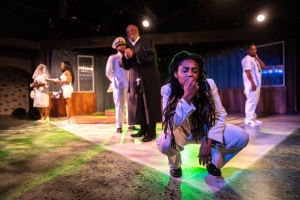
There are funerals where grief brings a family together, and then there are funerals where grief opens the door to everything a family has spent years trying to keep buried. In Hayward, playwright Netta Walker turns a father’s funeral into a reckoning with family secrets, unresolved pain, and the ghosts that refuse to stay in the past.
Given a bold world-premiere production by The Gift Theatre, presented at Steppenwolf’s 1700 Theater, Hayward, directed by AmBer Montgomery, reimagines elements of Hamlet and Electra through the eyes of Luna, the youngest daughter in a deeply complicated family. On the day of her father’s funeral, Luna announces that his ghost has come to visit her. What follows is part family drama, part dark comedy, and part haunting exploration of the emotional inheritance passed from one generation to the next.
The play opens with a funeral, and from the moment the family enters, it is clear that this will be no ordinary farewell.
Luna (Ireon Roach), her father’s favorite child, is overwhelmed by grief as she stands at the podium to deliver his eulogy. Her siblings seem considerably less interested in mourning. Eric (Victor Musoni), dressed in a white memorial T-shirt and sagging pants, and Leila (Sydney Charles), wearing a white dress that seems decidedly inappropriate for the occasion, give the impression they would rather be anywhere else. Their oldest brother, AJ (Gregory Fenner), a military man, stands rigidly at attention, as though guarding the proceedings at a state funeral.
Seated apart from the chaos is Maria (Shanesia Davis), the family matriarch, dressed in white, her face veiled and a white handkerchief close at hand. She carries herself with the solemnity of a woman accustomed to holding a family together, even when its members threaten to tear one another apart.
(from left) Alfred Wilson, Gregory Fenner, Shanesia Davis and Ireon Roach in The Gift Theatre's presentation of Hayward at Steppenwolf’s 1700 Theater. Photo by Joe Mazza / Brave Lux.
During the service, Luna sees her deceased father, Tony (Watson Swift). Her vision is quickly dismissed, but the encounter signals that something deeper is happening within this family. At the gravesite, the arrival of Uncle Johnson (Alfred Wilson), who is also a pastor, adds another layer of tension. There is little pastoral comfort in Johnson’s approach. He berates the family, directing particular hostility toward Luna because of who she is.
Religion, family expectations, and personal identity collide, and the resulting arguments reveal a household where love and resentment have become inseparable. The siblings fight, challenge one another, and expose old wounds, yet beneath their dysfunction is a recognizable bond. They may not know how to care for one another gracefully, but the connection remains.
At the center is Luna, whose grief is both the most visible and the most unsettling. Her father’s visits are not simply a supernatural manifestation of mourning; he has a request for her that reaches beyond the grave. As the family’s history unfolds, we learn that Tony served in the military during the Gulf War and returned carrying psychological wounds. The play suggests that the trauma he experienced did not end with him. His children, particularly Luna, may have inherited some of the emotional consequences without fully understanding their origins.
Walker’s most compelling achievement is her creation of characters who feel genuinely complicated. These are not tidy theatrical portraits of a dysfunctional family. They are people whose behavior can be outrageous, infuriating, and unexpectedly tender, sometimes within the same scene. The comedy emerges naturally from their interactions, offering relief without entirely diminishing the pain beneath the laughter.
Montgomery has assembled a strong ensemble and directs the actors with a clear sense of purpose. One of the production’s funniest moments comes when Maria sits center stage and her children gradually gather around her, one by one, as if seeking the comfort of the family’s center. When the last child arrives, Maria simply gets up and leaves them together. The gesture is hilarious, revealing, and familiar to anyone who has watched a family matriarch reach the limits of her patience. It is a moment best experienced rather than explained.
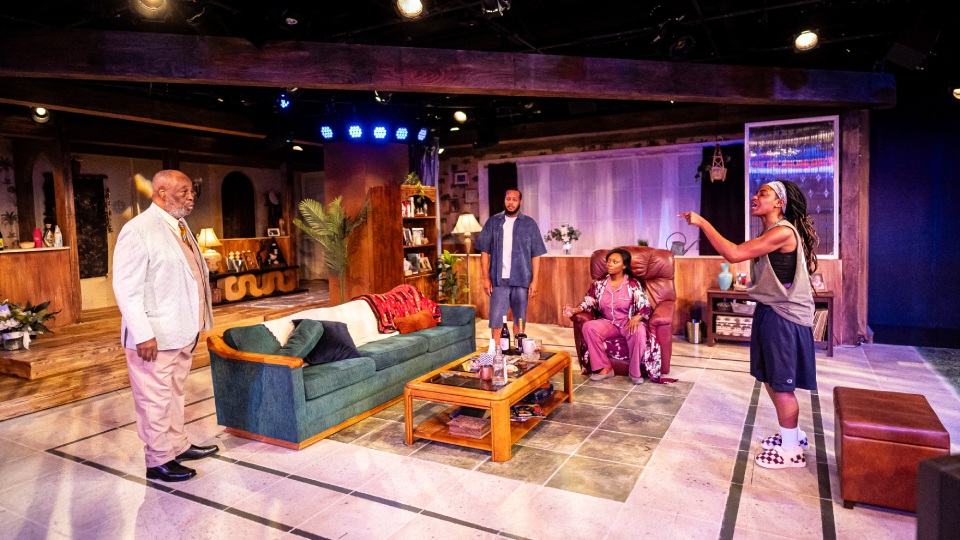
The scenic design is another notable achievement. The stage transforms from a church to a gravesite and eventually into the family’s living room. The final home setting is impressively detailed, providing a convincing domestic space in which the family’s conflicts can continue to unfold. My reservation is the time required to complete the transformation. Although the finished environment is effective, the process of getting there interrupts the production’s momentum.
Ultimately, Hayward is an entertaining and ambitious work that uses humor, supernatural elements, and family conflict to examine the lasting effects of trauma. Walker’s play is interested in the emotional territory families occupy: the memories they avoid, the wounds they pass along, and the love that survives even when they struggle to express it.
Still, the play would benefit from sharpening its central argument about mental health. Tony’s military service and the suggestion of inherited trauma offer fertile ground, but the relationship between psychological injury, family behavior, and Luna’s experiences could be developed with greater clarity. The subject deserves more than implication, particularly when the play so effectively demonstrates how one person’s unresolved pain can shape an entire household.
With its memorable characters, dark humor, and committed performances, Hayward offers a lively and often moving portrait of a family trying to find its way through grief. Like a Floridian-style shiva, the gathering is noisy, irreverent, and emotionally unpredictable. The dead may have been laid to rest, but in this family, the past is very much alive.
RECOMMENDED
When: Through Nov. 15
Where: Steppenwolf’s 1700 Theatre 1700 N. Halsted St. Chicago
Tickets: $45 - $50
Court Theatre’s "A Raisin in the Sun": Bold Choices, Timeless Struggles

Like the dream deferred in Langston Hughes' poem that inspired its title, Court Theatre's latest production of "A Raisin in the Sun" simmers, sags, and occasionally explodes with raw intensity. Director Gabrielle Randel-Bent's contemporary vision crackles with urgency, even as it wrestles with the delicate balance between modern resonance and historical authenticity.
Andrew Boyce's masterful set design emerges as the production's crowning achievement. His deconstructed Chicago kitchenette apartment becomes a character itself – a cramped urban cage where privacy is as scarce as hope. The shared bathroom, visible just beyond the family's domain, serves as a constant reminder of the Youngers' station in life. Outside the city of Chicago pushing its way in threatening to devour the inhabitants in grit and grime.
The stellar ensemble breathes fierce life into Hansberry's beloved characters. Shanesia Davis anchors the production as family matriarch Lena Younger, while Brian Keys brings explosive energy to Walter Lee – though his visible tattoos create an unfortunate distraction that pulls us from the 1950s setting. Martasia Jones commands the stage as Beneatha, imbuing the aspiring doctor with a perfect blend of youthful idealism and sharp intellect. Her scenes of intellectual sparring sizzle with wit and passion, though the choice to smoke cigarettes in Mama's apartment strikes an implausible note in an otherwise masterful performance.
Kierra Bunch brings a quiet strength to Ruth Younger, crafting a deeply nuanced portrait of a woman stretched to her breaking point. Her scenes with Walter Lee pulse with complicated history – love and resentment, hope and exhaustion all tangled together. When she finally breaks down over her pregnancy, the moment is devastating in its restraint. Her joy is unbridled when she learns of the family's plan to buy a home.
Charles Andrew Gardner brings the perfect presence to George Murchison, making the most of his limited stage time. His polished demeanor and cutting wit provide the perfect foil for Beneatha's revolutionary spirit, while hints of vulnerability beneath his assured exterior add welcome complexity to what could have been a one-note character.
J. Nicole Brooks steals her scene as the nosy neighbor Mrs. Johnson, delivering gossip and judgment with such gleeful spite that you can't help but love to hate her. Her brief appearance provides crucial comic relief while underlining the community's complicated relationship with social mobility.
Julian Parker's Bobo's locs hairstyle is out of place for the time. It's distracting and makes it hard to believe Walter Lee would trust him with his dream of business ownership.
While the performances ground the production in emotional truth, Randel-Bent's modernizing choices create an intriguing tension between past and present, sometimes to the detriment of Hansberry's carefully crafted world.
Raquel Adorna's costume choices prove particularly puzzling: Joseph Asagai (Eliott Johnson) appears more Wall Street than West Africa when we first meet him in his Brooks Brothers-esque suit. At the same time, Karl Lindner (Vincent Teninty) inexplicably dons plumber's attire instead of the more historically and dramatically appropriate business suit of a "welcoming committee" representative. Young Travis (Jeremias Darville) sports an out-of-place cowboy ensemble, making him seem too old for both the outfit and the role as well as being an unlikely splurge for a family counting pennies.
Willow James' sound design walks a delicate tightrope between past and present, largely succeeding until a jarringly anachronistic moment when Walter Lee and Ruth dance to Chaka Khan's "Sweet Thing" – a choice that catapults us decades ahead of the play's setting.
“A Raisin in the Sun" hits different today than it did in 1959, but its truths cut just as deep. Sure, the Younger family's dream of owning a home in a white neighborhood might look different in 2025, but their story - fighting against systemic barriers, sacrificing for family, and refusing to let hope die - that's as real now as ever. The play nails something timeless about the American Dream: how it promises everything but keeps moving the goalposts for some folks. When Mama tends to that struggling plant, she's not just growing a flower. She's showing us how Black families keep pushing forward, generation after generation, despite the odds. Whether it's redlining in the '50s or today's housing discrimination Hansberry's message rings true: dreams don't come easy, but they're worth fighting for. That's why this play still packs theaters - it's not just history, it's tomorrow's headlines.
RECOMMENDED
When: Through March 9 *Extended through March 23rd
Where: Court Theatre, 5535 S. Ellis Ave.
Running time: 2 hours, 50 minutes
Tickets: $58 - $100.00 Student, Group and military discounts available
773-753-4472
Hamlet with Smart Phones and a Good Measure of Verve

The tiny Gift Theatre, occupancy 50, has bitten off a big challenge with its determination to present Hamlet. Featuring Daniel Kyri in the title role of Shakespeare’s classic, director Monty Cole has hewed to the melodious Elizabethan English of the script.
The production has contemporary touches that largely respect the genius of the playwright, while delivering a show that the author would recognize, and which conveys the crucial dramatic conflicts. And, a mark of a serious production, Cole and cast examine anew the mysteries that will ever surround the motives and actions of the characters.
In a nutshell, young prince Hamlet suspects his mother Gertrude and uncle Claudius are complicit in the recent death of his father, King Hamlet. The two have married, and for the rest of the play Hamlet works through his feelings of anger and guilt, goaded by ghostly appearances of his father. Hamlet’s girlfriend Ophelia, her brother Laertes and their dad Polonius are killed in the fallout. Likewise for Claudius and Gertrude.
Producing any play requires envisioning and mastering the drama, psyching out characters and motivation, getting the script down. With Shakespeare, you also must account for the specific challenge of a language in iambic pentameter, and at times florid or obscure.
So Shakespearean acting is its own special skill. The cast has largely nailed the motivation and inculcated it to their roles on stage, delivering moving performances with conviction. But, alas, the language suffers a few slings and arrows along the way – though there are bright spots – including a rap version of one monolog that was very successful.
From the moment she appears, silently regal, completely in touch with the Gertrude, Shanesia Davis shows how it’s done. Her every line is immediately clear, even when we are uncertain of an archaic word or phrase – we totally understand her. Davis acting background makes it clear why – she has a lot of experience with Shakespearean roles.
Daniel Kyri has captured young Hamlet, and we ride with him through his internal turmoil. But Kyri is still working through what is one of theatre’s most demanding roles. Of those seven famous Hamlet soliloquies, I felt he did best with the fifth (“Tis now the very witching time of night, When churchyards yawn, and hell itself breathes out”) and the sixth (“Now might I do it pat now he is praying, And now I'll do it, and so he goes to heaven.”)
Netta Walker’s performance as Ophelia was balanced and well done. Martel Manning as actor Guildenstern and the very funny Grave Digger, had a magnetic presence on stage. Gregory Fenner as Laertes has all the passion and constrined fury required. Alexander Lane carries a military strength and sinister swagger in his three roles as Fortinbras, Valteman and Marcellus.
Not everything works, though most things do. Cole, who spent a year in the development of the show, keeps the play in its historic setting, but the production is unconstrained by period dress. Several younger characters have smart phones, and somehow, these make sense. They are used as flashlights in some scenes, and Ophelia sings along with her earbuds in. Smart phones are now a normal human appendage, like eyeglasses, and are almost invisible in their roles in the show.
The set was nice – a classic paneled plaster hallway illuminated by sconces with decaying carpeting on the floor, the edges lined by weeds and smashed beer cans. William Boles did scenic design, but I do quibble with whoever made the decision to encase the stage in a box of acrylic sheets, so the actors play behind a “glass.” This muted the sound and an effort to mic the space was unsuccessful.




Latest Articles
-
 Music Theater Works' HAIRSPRAY starring Ru Paul's Drag Race's Mrs. Kasha Davis comes to North Shore Center for the Performing Arts December 17 - January 3
Written by Buzz Center StageMusic Theater Works is proud to announce the cast and creative team for the final production of its 2026 season, Hairspray, in the George Van Dusen Theatre, at the North Shore Center for the Performing Arts in Skokie, 9501 Skokie…
-
Redtwist Theatre presents world premiere of FLYING MONKEYS, directed by Robert Falls December 6 - January 17
Written by Buzz Center StageAward-winning Redtwist Theatre announces the cast and creative team for this added special engagement to its 2026 - 2027 season, the world premiere of Flying Monkeys, produced in collaboration with the New Theatre Project, December 6 - January 17, 2027,…
-
Shattered Globe Theatre Presents THE WATERFALL - January 22 – February 27, 2027 at Theater Wit - Midwest Premiere!
Written by Buzz Center StageShattered Globe Theatre is pleased to continue its 36th Season with the Midwest premiere of Phanésia Pharel's emotionally rich two-hander The Waterfall, directed by Jasmine B. Gunter and featuring Shanésia Davis and Jaeda LaVonne. The Waterfall will play January 22 –…
-
 Audiences Will Fall in Love with Northlight's All the World
Written by Angelo CamposWhen two actors share the stage show after show, how long can they keep their real feelings from stealing the spotlight? Lauren Gunderson’s All the World opened at Northlight Theatre with splendid, perceptive theatricality, as it follows two performers whose…
Does your theatre company want to connect with Buzz Center Stage or would you like to reach out and say "hello"? Message us through facebook or shoot us an email at This email address is being protected from spambots. You need JavaScript enabled to view it..
*This disclaimer informs readers that the views, thoughts, and opinions expressed in the text belong solely to the author, and not necessarily to Buzz Center Stage. Buzz Center Stage is a non-profit, volunteer-based platform that enables, and encourages, staff members to post their own honest thoughts on a particular production.