
Displaying items by tag: Chicago
The Dancing Delivers What the Dialogue Doesn’t in Dirty Dancing: The Musical
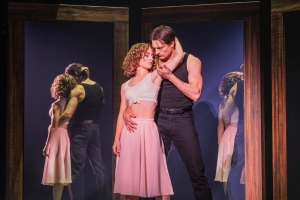
In a world of theatrical adaptations, there really are two kinds: some reinvent their source material, becoming their own “new” art, while others understand that the real pleasure they provide is in the audience seeing some beloved thing from the past brought back to life. Dirty Dancing: The Musical falls firmly into the second category. Is it a great musical? Not quite. But that’s not its purpose. As a pop-culture ritual connecting a multigenerational audience over their shared love of a movie (which never tried to be “great” cinema, either), it is undeniably effective. And with Dancing with the Stars returning next week (surely a favorite for this musical’s audience), the timing of this particular Broadway in Chicago production’s exceptional ballroom dancing could not have been better.
With original screenplay and book by Eleanor Bergstein and direction by Lonny Price, the adaptation recreates the film largely through its familiar soundtrack, supplemented by a handful of original songs. It quickly becomes clear that the production was cast with dancing as its first priority. That choice pays off whenever the music takes over: the cast members are remarkably skilled dancers, and the show’s most kinetic sequences capture the sensuality and excitement audiences expect from Dirty Dancing. Much of that impact comes from choreographer Darrell Grand Moultrie, whose work channels the film’s sensuality and athleticism with precision.
That energy largely disappears, though, when the dancing stops. Unfortunately, dialogue is often delivered with a stiffness that makes the performances feel robotic, leaving little sense of genuine connection between the characters. The chemistry missing from Baby and Johnny’s romantic scenes is just as absent from the story’s confrontations, friendships, and family relationships.
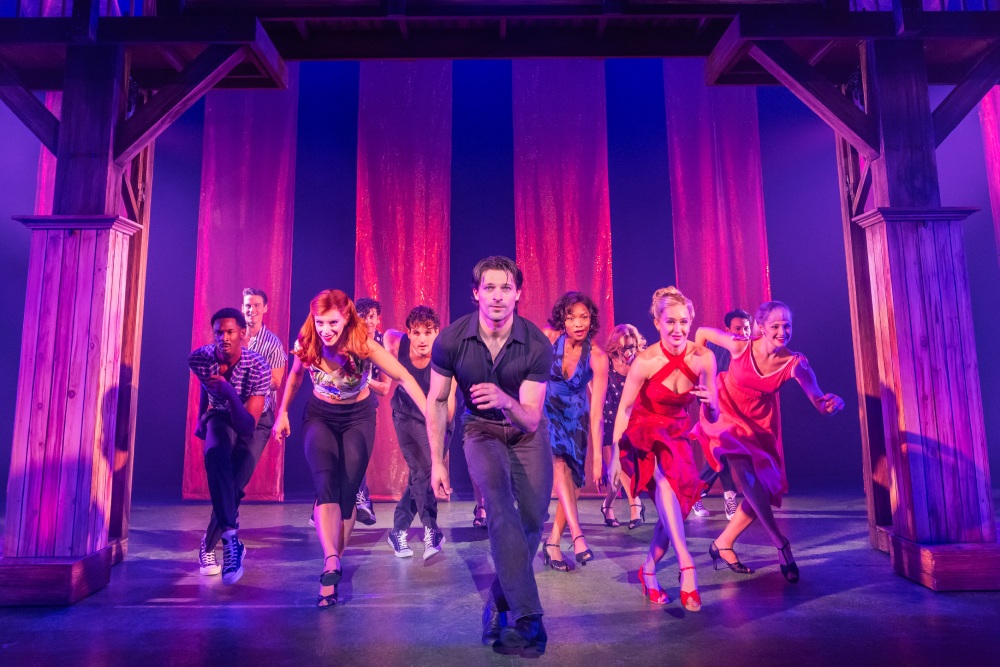
Blake Zelesnikar (Johnny Castle) and the DirtyDancing: The Musical Company. Photo by Matthew Murphy.
Almost as noticeably, the ensemble rarely displays the tight-knit community that should exist among Kellerman’s dance staff. These characters live and work together within the same rigid system; their relationships should feel immediate and deeply established. Instead, much of the large cast feels underutilized, when not simply crowded on the stage. The exception is the final number at the end-of-season talent show, when everyone suddenly moves with the same electric energy. It sends the audience out on an undeniable high, while also revealing how much more vibrant the entire production could have felt with that sense of spirit throughout.
Vocally, the cast is professional and polished, with two extraordinary exceptions: Ethan Peterson as Billy Kostecki and Ashley LaLonde as Elizabeth. Their voices are absolutely stunning. Nearly every pin-drop emotional moment in the production comes not from the dramatic plot, but from one of them singing.
Alongside its dancing among the production’s greatest triumphs is its scenic design, which transports us to the 1960s Catskills. The work of scenic designer Brett J. Banakis, costume designer Linda Cho, and lighting designer Japhy Weideman is central to creating that world. The set does not rely on spectacle or theatrical magic but is astonishing because it’s so perfectly planned and constructed to hold every corner of Kellerman’s – from polished guest spaces to humbler staff quarters, indoors and out. Seamless transitions allow locations to shift smoothly without interrupting the story’s momentum. I only wish the choreography had taken greater advantage of that flexibility, using the architecture to create more breakout moments for an ensemble overflowing with talented dancers.
Ultimately, Dirty Dancing: The Musical succeeds at recreating the movie onstage but rarely explores what live theatre could add to it.
But despite any limitations, this production provides exactly what its audience desired: an enjoyable night powered by nostalgia, tremendous dancing, and a finale worth waiting for – even if it never becomes an exceptional musical independent of the film audiences already love.
Dirty Dancing: The Musical runs at the James M. Nederlander Theatre through September 20th. Tickets are available at https://www.broadwayinchicago.com/shows/dirty-dancing-the-musical/.
Jackalope Theatre Company Announces The Cast And Creative Team For The World Premiere of Engines and Instruments of Flight: A Fantasia In Three Acts By Calamity West, November 11 - December 19
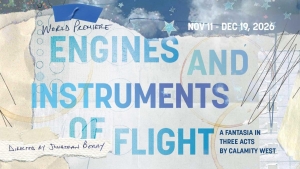
Jackalope Theatre Company, presenting the 17th Annual Newspaper Festival, August 20 - 24, is proud to announce the world premiere of Engines and Instruments of Flight: A Fantasia in Three Acts by Calamity West, written by Calamity West and directed by Jonathan Berry, November 11 - December 19, 2026, at Jackalope Theatre in the Broadway Armory Park, 5917 N Broadway St. The total running time, including one intermission, is two hours and 30 minutes. Preview performances are Wednesday, Nov. 11, Friday, Nov. 13 and Saturday, Nov. 14 at 7:30 p.m. and Sunday, Nov. 15 at 2 p.m. The performance schedule is Mondays, Fridays and Saturdays at 7:30 p.m. and Sundays at 2 p.m. with no Friday, Nov. 27 or Saturday, Nov. 28 performances. Tickets are $20 - $45 with student and Edgewater resident discounts available. Subscription and single tickets are now available at JackalopeTheatre.org or call/text the box office at 773.340.2543.
Calamity West is conjuring a fantasia: It’s 1986 New York and Tony is a playwright who isn’t writing. As he and his closest collaborators search for meaning in an increasingly fractured America, figures from history begin appearing with agendas of their own. Engines and Instruments of Flight is a play about the magic of making theatre in a world that refuses to stand still.
The cast of Engines and Instruments of Flight: A Fantasia in Three Acts by Calamity West includes Raphael Diaz (he/him, Henry); Julian Hester (he/him, William); Niko Kourtis (he/him, Tony); Andrew Burden Swanson (he/him, Calvin); Johnard Washington (he/him, Gene) and Mary Williamson (she/her, Eleanor).
The creative team for Engines and Instruments of Flight: A Fantasia in Three Acts by Calamity West includes Calamity West (she/her, playwright); Jonathan Berry (he/him, director); Salman Lee (he/him, assistant director); Tianxuan Chen (she/her, scenic and lighting designer); Delena Bradley (she/her, costume designer); Steve Labedz (they/them, sound designer); Courtney Abbott (they/she, intimacy coordinator); Madie Doppelt (she/her, script advisor); E Tylkowski (they/them, production manager); Tseela Sokolin-Maimon (she/her, stage manager); Mayah Jaimes (they/them, assistant stage manager) and AJ Links, CSA (she/her, casting director).
ABOUT CALAMITY WEST, PLAYWRIGHT
Calamity West is the 2026 recipient of the Laurents/Hatcher Foundation Award, one of the nation’s most significant prizes for new American plays, for her play FEAST!. Originally developed in New York at Primary Stages through the Dorothy Strelsin New American Writers Group, FEAST! received further development at the Lucille Lortel Theatre. West’s work has been produced, commissioned and developed by some of the country’s leading theatrical institutions including The Public, Williamstown Theatre Festival, Roundabout Theatre Company, the Lee Strasberg Theatre and Film Institute and Jackalope Theatre Company. From 2022 to 2026, West was an invited member of Primary Stages’ Dorothy Strelsin New American Writers Group, where she wrote three new plays: FEAST!, Sgt. Hank Cole’s Drama Club of Algona and PARALLAX. Her body of work also includes In the Canyon, Give It All Back, Rolling and Greetings from Moscow: A Love Story. West’s Engines and Instruments of Flight: A Fantasia in Three Acts is receiving its world premiere at Jackalope Theatre Company to be followed by the world premiere of FEAST! at Goodman Theatre, February 27 - March 28, 2027.
ABOUT JONATHAN BERRY, DIRECTOR
Jonathan Berry is a Chicago-based director, producer, educator and is the recently appointed artistic director at Raven Theatre. For Jackalope, he directed the world premiere of The Casuals. He was an artistic producer at Steppenwolf, where directing credits include: Lindiwe, The Children, You Got Older, Constellations, Curious Incident… and The Crucible. Other work includes: Steep Theatre (Company Member): Paris, Birdland, Red Rex, The Knowledge, Festen, Moment and The Resistible Rise of Arturo Ui. Griffin (Company Member): The Harvest, Balm in Gilead, Golden Boy, Spring Awakening, Punk Rock, Port, Company and Picnic. Other credits include Roundabout Theater: Suicide, Incorporated; Gift Theatre: the remount of Obliterarion, the world premieres of Dirty and Suicide, Incorporated and at Goodman Theatre: The Solid Sand Below and The World of Extreme Happiness for New Stages. Assistant director for Broadway productions of Of Mice and Men and This is Our Youth. He taught classes at UIC, Columbia College, Northwestern and was instrumental in leading the ensemble training program, The School, at Steppenwolf. For three years, he served as artistic director of the Penobscot Theatre Company in Bangor, Maine.
Coming Up from Jackalope:
17th Annual Living Newspaper Festival
August 20 - 24
Press Opening: Thursday, Aug. 20 at 7:30 p.m.
Performance Schedule: Thursday - Saturday at 7:30 p.m., Sunday at 3 p.m. and Monday at 7:30 p.m.
The Broadway Armory, 5917 N Broadway
JackalopeTheatre.org/2025-2026
Tickets: $20 - $35
The Living Newspaper Festival is inspired by the 1930s Living Newspapers of the Federal Theatre Project that created stories based on recent events. This year’s Festival includes world premieres inspired from recent news headlines.
Performances, show times, dates are subject to change.
ABOUT JACKALOPE THEATRE
Jackalope Theatre Company expands the definition of American Identity by engaging with communities to produce works that celebrate diverse perspectives. Jackalope is a premier home for new and exciting Off-Loop Theatre based in Chicago's Edgewater and Rogers Park neighborhoods. They are committed to cultivating new voices that contribute to an expanding American culture and mythology. Each season, Jackalope produces full-length plays, new play development programming and provides free classes in partnership with the Chicago Park District.
Jackalope Theatre Company, presenting the 17th Annual Newspaper Festival, August 20 - 24, is proud to announce the world premiere of Engines and Instruments of Flight: A Fantasia in Three Acts by Calamity West, written by Calamity West and directed by Jonathan Berry, November 11 - December 19, 2026, at Jackalope Theatre in the Broadway Armory Park, 5917 N Broadway St. The total running time, including one intermission, is two hours and 30 minutes. Preview performances are Wednesday, Nov. 11, Friday, Nov. 13 and Saturday, Nov. 14 at 7:30 p.m. and Sunday, Nov. 15 at 2 p.m. with the press opening Tuesday, Nov. 17 at 7:30 p.m. The performance schedule is Mondays, Fridays and Saturdays at 7:30 p.m. and Sundays at 2 p.m. with no Friday, Nov. 27 or Saturday, Nov. 28 performances. Tickets are $20 - $45 with student and Edgewater resident discounts available. Subscription and single tickets are now available at JackalopeTheatre.org or call/text the box office at 773.340.2543.
The Beautiful Overthinking of Gary Gulman’s 7th Hour
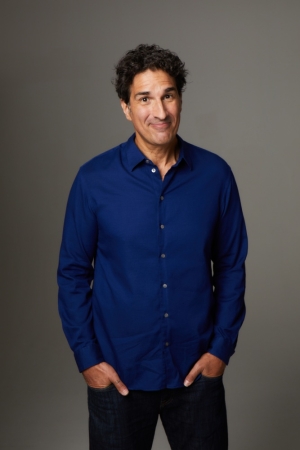
Gary Gulman brings his new tour, 7th Hour: An All New Standup Show, to The Den Theatre, offering Chicago audiences a chance to see a comic who has spent decades refining the long-form, slow-burn style that has become unmistakably his. His five sold-out shows over the weekend are being recorded for an upcoming comedy special, giving each performance an added spark as he works through material with both confidence and care. Gulman’s comedy has always lived in the space between sharp observation and gentle self-reflection, and this latest set continues that progression with a mix of wry honesty and carefully shaped storytelling. His stop at The Den feels less like a routine tour date and more like a chance to watch a veteran performer stretch into new territory while still delivering the precision that has made him one of stand-up’s most quietly dependable voices.
The evening opened with Evanston’s own Sam Froum, whose set proved to be a sharp and genuinely funny warm-up for the night. He brought an easy confidence and a quick, clever rhythm to the stage, landing jokes with the kind of timing that immediately pulls a room in. It was a strong showing, and a fitting lead-in to Gulman’s tightly built headlining act.
Across 7th Hour, Gulman moves through a wide constellation of personal history, weaving together stories that span his depression, his admiration for his father’s unwavering integrity despite the loss of friends it may have cost him, and the realities of growing up with a single mother while navigating the rough edges of two bullying older brothers. His Jewish upbringing becomes a recurring thread, most notably in an extended, delightfully overthought retelling of the story of Moses - a bit that shifts from biblical epic to neurotic character study in a way only he can pull off. From there, he wonders aloud why Jewish people didn’t simply “like” Jesus so that Christianity might have evolved into an upbeat, colorful, pastel-tinted sect of Judaism, only to immediately challenge his own premise with the kind of self-correcting logic that fuels his best material. That exploration leads him into Jesus’ Sermon on the Mount, where he zeroes in on “do unto others as you would have them do unto you,” a phrase he deeply takes to heart, breaking it down with methodical curiosity as he imagines Jesus trying it out in front of smaller crowds at "open mounts" before delivering it on the big stage. Along the way, he has fun with the apostles - especially John and “Doubting” Thomas - treating them less as distant religious figures and more as characters he can analyze, tease, and reinterpret through his own gently overthinking lens. He even slips in a detour to Christian Bale’s Batman, acting out a hilarious gravel‑voiced exchange with Gary Oldman’s Commissioner Gordon that fits seamlessly into his stream of overthought observations.
He also devotes time to the values and education he drew from PBS, especially the steady presence of Mr. Rogers, whom he references with undeniable affection. Gulman lights up when recalling – and briefly singing – the closing song, “It’s Such a Good Feeling,” along with the simple but radical reassurance Mr. Rogers offered at the end of each episode: “I like you just the way you are.” He treats that sentiment with an earnest respect that shows how deeply it shaped him, even as he wonders aloud how anyone can truly live as their full, unfiltered self outside of a very small circle of people. He folds in humorous family stories tied to pledge drives, broadening the emotional palette of 7th Hour and grounding the comedy in the cultural touchstones that helped him make sense of the world long before he ever stepped onstage.
Gulman’s humor is a distinct blend of long-form storytelling, analytical overthinking, gentle self-examination, and slow-burn observational detail. He builds jokes the way essayists build arguments - layering premises, revisiting ideas, correcting himself mid thought, and letting the comedy emerge from the precision of his logic as much as from the punchline. His style is warm, meticulous, literary, and deeply human, often turning small moments from childhood, religion, or pop culture into sprawling, carefully engineered comedic set pieces.
And in 7th Hour, he brings that entire toolkit with him - sharper, fuller, and more emotionally grounded than ever. The show feels like Gulman operating at the height of his powers, shaping personal history into comedy with a confidence that suggests he knows he’s building material worthy of an upcoming special. What stands out most is how fully he leans into that mastery; 7th Hour plays like a comic working with total clarity of purpose and delivering exactly the kind of work only he can create.
Gulman’s career has been shaped by a steady run of smart, carefully built specials that highlight his gift for long-form comedy. From Boyish Man and In This Economy? to the critically praised It’s About Time and The Great Depresh, he has assembled a body of work defined by warmth, clarity, and an almost literary sense of structure. His stand-up has also been a reliable presence on late-night television, with memorable sets on Conan, The Late Show with Stephen Colbert, Jimmy Kimmel Live, and The Tonight Show, each showcasing his ability to turn everyday frustrations and cultural quirks into slow-building, sharply observed stories. Together, these appearances have cemented him as one of the most consistent and quietly influential voices in contemporary stand-up.
If you get the chance to see Gulman live, take it. 7th Hour shows a comedian in full command of his craft, delivering work that is thoughtful, funny, and unmistakably his. It’s the kind of performance that reminds you why stand-up, at its best, feels both intimate and expansive at the same time.
All The World's a Stage and Chicago Merely The Best Player: 'As You Like It' in Chicago Parks this summer
Is there anything more alluring than a summer night in Chicago? The lakefront beaches, the meandering pathways, the festivals and street foods, the hidden gardens where free art productions are staged, whatever you like, you can find it in the city during summer evenings. There is no shortage of parks to explore or cultural events to experience, thanks in part to the Mayor’s Night Out in the Parks program that partners with organizations to stage free artistic experiences in neighborhood parks all around the city. One such organization kicked off its summer series with a spectacular – and free – performance of Shakespeare’s As You Like It, now playing throughout Chicago parks through August 2nd.
Shakespeare’s As You Like It is a comedy that follows Rosalind and Orlando, two lovers who each run away from their own political and familial problems and escape into the Forest of Arden. Disguised as a shepherd boy, Rosalind finds Orlando and convinces him to woo her under the guise of curing him of his love for Rosalind. Multiple couplings occur, lessons of life and love are expounded on, and, as every Shakespeare comedy does, As You Like It ends with a wedding – four to be precise.
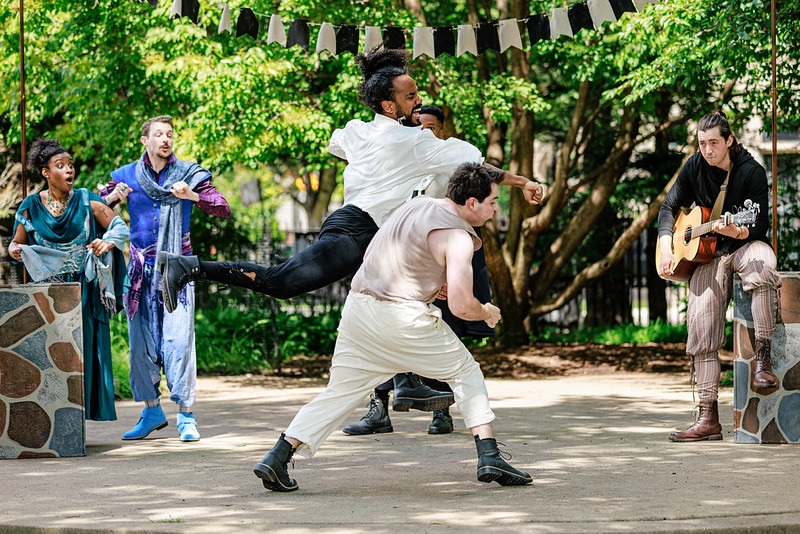
foreground - Thomas Russell and Connor O. Locklin. Photo by Steven Townsend, Distant Era.
As You Like It is the 2026 production of Midsommer Flight, a theatre troupe that stages high-quality, accessible performances of Shakespeare’s plays in Chicago. Directed by Producing Artistic Director Beth Wolf, this summer’s production continues to delight audiences and draw crowds, presenting free performances to Chicago communities that aim to bring people together. Midsommer Flight is an Arts Partner with Chicago Park District and a participant in the Mayor’s Night Out in the Parks initiative. They will be performing the classic Shakespeare comedy throughout the summer at different neighborhoods throughout the city, but if you think you’ve seen a Shakespeare production, (seen one, seen them all, right?) I beseech you to venture to one of the parks. At the best of times, Shakespearean stories can be difficult to follow: analogous phrasing, double entendres, prosaic old-timey insults, and slurs; it’s not always easy to follow. Midsommer Flight, however, gives the old texts modernity, witty asides, and an expressive atmosphere that makes the play easy to follow and understand. The acting is superior, and the inclusivity is a delightful and refreshing display of humanity at its finest. Talent of the Midsommer Flight cast would rival that of any Shakespearean theatre company, charging hundreds of dollars for seats, and staging productions in grand halls. And the best part? The productions are completely free to the public. The accessibility, the garden park scenery, and the flowy costuming truly provide a magical experience, embodying the spirit, humanity, and beauty of the arts.
There are many benefits to living in and around the Chicagoland area, but summertime really brings out the best and brightest Chicago has to offer. Night Out in the Parks is but one of the many incredible accessible programs bringing cultural events to neighborhoods to “amplify the artistic and cultural vibrancy of our city in every neighborhood and enhance quality of life across Chicago.” Find out more about Night Out in the Parks here. When initiatives such as this meet the grassroots talent and love shown by Midsommer Flight, magic happens. Whether you like it because it’s in your local park or you like it because it is free, there is truly something for everyone this summer in Chicago. You can truly have it just as you like it. As You Like It will be performed outdoors at six Chicago parks through August 2nd. Learn more about Midsommer Flight and its mission, and check out the list of upcoming performances at parks throughout Chicago and reserve your free space today!
The Real Crime Would Be To Miss This: Crime and Punishment at TUTA Theatre

Real Chicagoans don’t gatekeep hidden gems. Whether it’s hidden bars behind laundromats, the best Billy Goat location (under Mag Mile), the best desserts or street tacos, the best place to catch a local game (insert season + sport), or a must-see show or concert, real Chicagoans share the hidden gems and surprise experiences. They share because it's thoughtful, considerate, and they want others to experience the same joy and elation they themselves experienced. Most importantly, they want to talk about the shared experience after, preferably at a hidden beach adjacent gem. Today’s hidden gem is TUTA, a theatre company staging a heavy-themed production of Crime and Punishment.

The story of Crime and Punishment follows the mental anguish and moral dilemmas of Rodion Raskolnikov, an impoverished former law student in Saint Petersburg who plans to kill an unscrupulous pawnbroker. The play is a stage adaptation of Fyodor Dostoevsky's 1866 novel of the same name, co-written by Marilyn Campbell and Curt Columbus. The authors of the adaptation condensed a heavily philosophical and psychological novel into a 90-minute, three-person play where the actors portray multiple characters without losing any of the depth or themes conveyed in the novel. Themes like isolation, morally gray ambiguity, faith, and fairness all still resonate today over 100 years later.

The TUTA Theatre (The Utopian Theatre Asylum) really proves that good things really do come in small packages. The small theatre found through an alleyway and accessed through a garage provided an unintentional eerie setting, winding your way to a small enclosure similar to the run-down windowless room the protagonist lives in. The minimalist-yet-evocative stage design also lent itself to the poignantly punishable psychology of Dostoevsky's play. By having Raskolnikov kneeling in dirt in supplication, having characters move behind sheer yet blurry plastic tarps, making you question if they were really there or if the character was descending into the madness of his own logic. In a way, the stage was the fourth cast member, moodily setting the tone with lights and effects that aided the claustrophobic and alienation the protagonist was showing on stage. And big talent filled the room with the incredible talent of TUTA company members Felix as Sonia, Huy Nguyen as Inspector Porfiry, and Clifton Frei as Raskolnikov.
TUTA is a fascinating theatre company with a pay-what-you-choose ticket structure. As a non-profit theatre, TUTA relies on ticket sales as well as grants, donations, and in-kind gifts of labor and talent to create art. For Crime & Punishment, for example, a price of $100 per ticket is what it would take to cover the costs of the production. By choosing a higher ticket price, you are creating opportunities for others to attend at lower prices who may not be able to enjoy this performance otherwise. If you want a guaranteed seat in the small theatre, reservations are available online, and you can choose one of four suggested prices ($20, $45, $60, and $100). The higher price you pay or donate, the more affordable future tickets can become throughout the production’s run time.

Whether a production is staged in a garage that borders the Brown Line or the finest auditoriums the city has to offer, Chicago proves time and time again that it houses a thousand treasures. And if you don’t know how to find them, don’t worry, there’s always a friendly Chicagoan ready to tell you all about it. Crime and Punishment is now playing at the TUTA Theatre (4670 N. Manor, Chicago) through August 23rd. To purchase reservations and guarantee a seat to the performance of your choice, visit www.tutatheatre.org. It'd be a Crime if you didn't get the chance to see this one.
This review is proudly shared with our friends at www.TheatreInChicago.com.
safronia soars at Lyric Opera

safronia at Lyric Opera of Chicago emerges as a deeply personal story of the Great Migration - one that resists grandiosity in favor of something more intimate, more lived-in, and ultimately more affecting. Drawn from the family history of Chicago’s inaugural Poet Laureate avery r. young, the work feels less like a conventional opera and more like an embodied poem, carried on breath, rhythm, and memory.
Young himself, as Fiery Baar Booker, gives a performance that is searing. There is fire in his portrayal - a man negotiating identity, displacement, and legacy. Opposite him, Maiesha McQueen’s Magnolia is the emotional anchor of the piece. Her performance radiates warmth and steadiness, embodying the sustaining force of family amid upheaval. She nurtures without sentimentality, giving Magnolia strength.
Lorenzo Rush Jr. brings a charismatic edge to King Willie Tate, a figure caught between aspiration and instability. His chemistry with Meaghan McNeal’s safronia is particularly compelling. McNeal delivers a spiritual performance - her safronia is less a single character than a vessel of generational memory, carrying the emotional weight of those who moved, hoped, and endured.

The company of safronia. Photo by Kyle Flubacher.
The looming presence of white power is sharply rendered through Zachary James as Cholly and Jeff Parker as Bossman. Their performances are unsettling not because they are exaggerated, but because they are so matter-of-fact. The banality of their authority underscores the systemic nature of the oppression the Booker family faces.
The ensemble - Bailey Haynes Champion, Sydney Charles, Miciah Lathan, Eric Andrew Lewis, Renelle Nicole, Jessica Brooke Seals, Maxel McLoud Schingen, and Kendal Marie Wilson - serves as a living chorus, shifting seamlessly between roles while maintaining a unified emotional pulse. They embody community, memory, and migration itself.
Musically, Paul Byssainthe Jr.’s conducting and orchestration weave together spirituals, blues, and textures into a soundscape that feels both rooted and expansive. Under Timothy Douglas’s direction, the production is carefully shaped, allowing stillness and movement to coexist in a way that honors the story’s emotional depth.
Yet for all its power, safronia at the Lyric Opera feels like a work yearning for closer quarters. Its most resonant moments are the quietest ones - the glances, the silences, the shared breath between performers and audience. It is fitting, then, that the production will be remounted at Court Theatre in May 2027. In that more intimate space, safronia may fully realize its potential, allowing audiences not just to witness the story, but to feel it - deeply, personally, and without distance.
This review is proudly shared with our friends at www.TheatreInChicago.com.
At Steppenwolf, Windfall Doesn’t Cash In on Its Promise

Steppenwolf Theatre Company’s, Windfall arrives with all the promise its pedigree suggests. Written by Academy Award–winning ensemble member Tarell Alvin McCraney and directed by Awoye Timpo, the production aspires to be a pulsing, lyrical meditation on grief, justice, and the uneasy intersection of activism and capitalism. What unfolds instead is a work rich in intention but frustratingly elusive in execution.
The play centers on a protest encampment that erupts into violence, culminating in the shooting of Eli, a member of Never Wrestle Justice - a group of activists unafraid to raise their voices. In the aftermath, Marcus (Glenn Davis), who has transitioned, lingers alongside his aging adoptive father, Mr. Mano (Michael Potts). Mano is left reeling, unable to fully accept the reported death of his child, Eli (Esco Jouléy). It’s a potent premise: a father who refuses to confirm his child’s death, a government eager to offer a financial settlement, and a moral dilemma that questions whether survival can - or should - be measured in dollars. Tarell Alvin McCraney frames the story as a “chosen family” drama, but the emotional foundation never fully coheres.
Marcus urges Mano to identify Eli’s body and accept the settlement, arguing that “blood money is still money.” Yet Mano resists, clinging to the unbearable ambiguity of loss. The arrival of various state representatives - played with dynamic range by Alana Arenas as First Lady, Miss Second, and The Last One - pushes the narrative into increasingly surreal territory. These figures, along with Jon Michael Hill and Namir Smallwood in multiple roles, embody a bureaucratic machine that is at once apologetic, predatory, and opaque.
There are flashes of McCraney’s signature lyricism, particularly in the spectral appearances of Eli. Whether ghost, memory, or manifestation of guilt, Eli’s presence should anchor the play’s emotional core. Instead, it muddies the stakes. When Eli ultimately reappears - alive, defiant, and ready to fight - the revelation feels less like a cathartic turn and more like a narrative sleight of hand that the play hasn’t earned.
This points to the central issue: the characters are too thinly drawn to sustain the weight of the play’s ideas. We see Mano’s grief, Marcus’s urgency to settle, and Eli’s activism, but we rarely feel them. The stakes, which should be life-altering, register as curiously low. Even the moral dilemma - to take the money or resist the system - never fully ignites because the emotional investment isn’t there.
Timpo’s direction leans into the play’s abstraction, emphasizing its communal and ritualistic elements. At times, this works; the staging has a fluidity that suggests a world where reality and memory bleed into one another. But the lack of clarity ultimately undermines the experience. Confusion becomes less a deliberate aesthetic choice and more a barrier to engagement.
There is also the question of place. Though the play is set in Chicago, it rarely feels rooted there. References to Rainbow Beach or Pequod’s Pizza read as surface-level markers rather than lived-in details. For a story so deeply tied to protest, policing, and community, the absence of a tangible sense of Chicago is a missed opportunity.
Still, the performances strive to elevate the material. Arenas is the undeniable standout, bringing vitality and nuance to each of her roles. Whenever she takes the stage, the play briefly finds its pulse. Potts lends dignity to Mano, though the script gives him limited room to build a fully realized arc.
McCraney has proven himself to be a playwright of profound depth and clarity. Windfall gestures toward that brilliance but never quite achieves it. It is a communal experience, yes - but one that leaves you searching for emotional and narrative footing long after the final moment fades.
Somewhat Recommended
When: Through May 31
Where: Steppenwolf Theatre, 1650 N. Halsted
Tickets: $20 - $148.50
Box Office: 312-335-1650
This review is proudly shared with our friends at www.TheatreInChicago.com.
WAITRESS & THE BOOK OF MORMON return to Broadway In Chicago by Popular Demand

|
Broadway In Chicago is excited to announce two fan-favorite shows are returning to our stages this year: WAITRESS and THE BOOK OF MORMON. Current subscribers can add these to their season package when renewing by clicking here or calling (312) 977-1717. Group tickets of 10 or more are now available for both productions by emailing This email address is being protected from spambots. You need JavaScript enabled to view it. or calling (312) 977-1710. Individual tickets will go on sale at a later date. For more information, see below or visit www.BroadwayInChicago.com. |
|
|
Eggs Pie.” When a baking contest in a nearby county — and a satisfying encounter with someone new — show Jenna a chance at a fresh start, she must find the courage to seize it. Change is on the menu, as long as Jenna can write her own perfectly personal recipe for happiness. |
|
|
|
|
Show calls it "Genius. Brilliant. Phenomenal." It’s THE BOOK OF MORMON, the nine-time Tony Award® winning Best Musical. |
|
|
|
ABOUT BROADWAY IN CHICAGO |
Merry Mischief in Windsor: Chicago Shakespeare’s Fast, Funny Triumph

Shakespeare’s comedies share a familiar architecture: mistaken identity, disguises, intersecting plotlines, a generous helping of prose, and language that delights in wordplay and double entendre. They are also, crucially, driven by sharp, intelligent women who often see more clearly than the men around them. With that foundation in mind, Chicago Shakespeare Theater’s production of The Merry Wives of Windsor leans confidently into these conventions - and then accelerates them - resulting in a delightfully mischievous evening.
Directed with precision and pace by Phillip Breen, the production wastes no time settling in. It moves briskly, almost breathlessly at times. Breen understands that comedy, especially Shakespearean comedy, thrives on rhythm. Doors must slam at just the right moment, disguises must be revealed a beat too late, and jokes must land before the audience has time to anticipate them. Here, the timing is razor-sharp, aided immeasurably by a cast of 22 actors who navigate the text with clarity and ease.
Max Jones’ set design cleverly situates Windsor in a contemporary world of affluence and quiet excess. This is a town where privilege is not just visible - it is assumed. Children attend private school, men play rugby, and women occupy a social sphere of lunches and shopping that doubles as a kind of informal power network. The Garter Inn, rendered as a dimly lit bar with a billiards table anchoring the space, becomes a playground for Falstaff’s schemes. In contrast, Dr. Caius’ sterile office reception area offers a clinical absurdity, while the Ford household gleams with white carpeting, glass, and sweeping staircases - its opulence undercut by the chaos unfolding within. A particularly fluid set change transforms the space with near-magic, reinforcing the play’s obsession with illusion and transformation. The final forest scene, textured with dirt mounds and trees, grounds the production just enough before it tips fully into theatrical fantasy.
What emerges most clearly in this production is the idea that Windsor is a world turned slightly askew. No one is quite what they claim to be. The knight, Sir John Falstaff, is anything but noble - he is vain, opportunistic, and gloriously ridiculous. The doctor, Caius, is less healer than hot-headed rival, perpetually threatening violence. The clergyman’s thick accent renders him a subject of humor rather than authority. Even the Justice of the Peace seems more eager for confrontation than civility. It is a community in which status is worn like a costume—and just as easily discarded.

Photo by Kyle Flubacker.
At the center of it all are the “merry wives,” who prove themselves to be the most grounded and perceptive figures on stage. Ora Jones’ Mistress Page and Issy Van Randwyck’s Mistress Ford anchor the production with wit and composure. They are never merely reactive; they orchestrate the action, turning Falstaff’s attempted manipulation into a series of escalating humiliations. Their intelligence drives the comedy, ensuring that the laughter always has a point of view.
The supporting cast is equally strong. Chike Johnson’s Master Page exudes an easy confidence, while Timothy Edward Kane’s Master Ford leans fully into the character’s jealousy, finding both humor and unease in his suspicion. Nate Burger’s Dr. Caius is a comic standout, his bluster and indignation landing with delightful force. Nancy Voigts brings a bustling energy to Mistress Quickly, threading together the play’s many schemes, while Paul Oakley Stovall’s Justice Shallow captures the absurdity of self-importance.
And then there is Jason Simon’s Falstaff - a performance that embraces the character’s excess without apology. Legend has it that Queen Elizabeth I so adored Falstaff that she demanded to see him in love. Here, however, Falstaff is in love with nothing so much as himself. Simon leans into that vanity, crafting a figure who is both despicable and irresistibly watchable. His repeated downfalls never diminish him; instead, they reveal the elasticity of his ego.
Ultimately, this production succeeds because it trusts the mechanics of Shakespearean comedy while fully committing to its world. Disguises are embraced, identities are blurred, and language sparkles with innuendo. Yet beneath the laughter lies a sharper observation: that power, status, and even identity itself are often performances. In Windsor, everyone is playing a role - some just play it better than others.
Highly Recommended
When: Through May 3
Where: Chicago Shakespeare Theater 800 East Grand Avenue in Chicago
Tickets: $60 - $120
Box Office: 312-595-5600
Info: www.chicagoshakes.com
This review is proudly shared with our friends at www.TheatreInChicago.com.
A Spoonful of Magic: Lyric Brings Mary Poppins to Life

Lyric Opera of Chicago’s film‑with‑live‑orchestra series has become one of the city’s most engaging hybrid arts experiences, transforming the opera house into a cinematic concert hall where classic films gain new dimension through live performance. Recent presentations such as Singin’ in the Rain (February 2025) and Coco in Concert (October 2025) have showcased how a full orchestra can elevate familiar scores, bringing warmth, clarity, and emotional immediacy to every musical moment. The format takes full advantage of Lyric’s grand acoustics and visual scale, allowing audiences to rediscover beloved movies with a heightened sense of drama and immersion. It’s a rare blend of nostalgia and spectacle - a celebration of film and music that feels both timeless and newly invigorated each time the orchestra begins to play. Now, the series continues its momentum as Anthony Parthner leads The Lyric Opera of Chicago Orchestra in performing the cherished score to Mary Poppins.

Dick Van Dyke and Julie Andrews in Mary Poppins.
Released in 1964 and starring a dream duo of Dick Van Dyke and Julie Andrews, Mary Poppins follows the magical arrival of an extraordinary nanny who descends - quite literally - into the lives of the Banks family on Cherry Tree Lane. As the children, Jane and Michael struggle under the strict expectations of their distracted father and the anxieties of their well‑meaning mother, Mary Poppins brings order, wonder, and unexpected joy through a blend of firm guidance and whimsical adventure. With the help of her cheerful friend Bert (the loveable chimney sweep), she leads the family through imaginative escapades that reveal deeper lessons about connection, kindness, and the importance of seeing the world with curiosity. By the time she departs, the Banks household has been transformed, not by magic alone, but by the rediscovery of affection and unity.
This film is an ideal showcase for the Lyric Orchestra, and they rise to it beautifully. The score for Mary Poppins was composed by the celebrated songwriting team Richard M. Sherman and Robert B. Sherman, whose work helped define the sound of Disney’s mid‑century musical era. Known as the Sherman Brothers, they created a bright, whimsical, and emotionally rich collection of songs that blend clever lyricism with instantly memorable melodies. Their contributions to the 1964 film produced some of Disney’s most enduring musical moments - from the exuberant “Supercalifragilisticexpialidocious” to the gentle poignancy of “Feed the Birds” - shaping a sonic identity that remains inseparable from the film’s legacy. Their score not only set the tone for Mary Poppins but also solidified the Shermans as two of the most influential composers in the Disney canon.

Conductor Anthony Parnther.
Lyric Opera of Chicago was especially thrilled to welcome Anthony Parnther to the podium, a conductor whose versatility and musical sensitivity made him an inspired choice for a score as iconic as Mary Poppins. One of the busiest conductors in Los Angeles and a world‑class bassoonist with an international performance career, Parnther brought both technical precision and a keen ear for orchestral color - qualities that served him well in shaping a live performance of this beloved film soundtrack. Watching him work was a genuine pleasure. His approach emphasized clarity and warmth, guiding the orchestra in a way that honored the Sherman Brothers’ classic melodies while subtly enhancing the film’s emotional contours in real time. For Lyric, his leadership reflected not only artistic excellence but a continued commitment to presenting musicians who could seamlessly bridge concert performance with cinematic storytelling.
With the success of its recent live‑to‑film presentations, Lyric’s film‑with‑live‑orchestra series continues to build steady momentum, and the company is already preparing for its next project: a live orchestral performance of Amadeus in 2027. Mary Poppins in Concert Live to Film is presented in a limited engagement on April 10 and 11. Click here for more information.
This review is proudly shared with our friends at www.TheatreInChicago.com.



Latest Articles
-
 Operation Mincemeat: A Smart, Scrappy Musical That Shines When Its Cast Takes the Wheel
Written by Maddie BurroughsIn the 2019 film Yesterday, a struggling musician wakes up in a world where The Beatles never existed. A similar theatrical case study could be done with every musical that might not exist without Hamilton; Operation Mincemeat should be first…
Operation Mincemeat: A Smart, Scrappy Musical That Shines When Its Cast Takes the Wheel
Written by Maddie BurroughsIn the 2019 film Yesterday, a struggling musician wakes up in a world where The Beatles never existed. A similar theatrical case study could be done with every musical that might not exist without Hamilton; Operation Mincemeat should be first… -
 MAMMA MIA! and HADESTOWN Return to Chicago in Spring 2027
Written by Buzz Center StageBroadway In Chicago is excited to announce two fan-favorite shows are returning to our stages this year: MAMMA MIA! and HADESTOWN. Current subscribers can add these to their season package when renewing by clicking here or calling (312) 977-1717. Group…
MAMMA MIA! and HADESTOWN Return to Chicago in Spring 2027
Written by Buzz Center StageBroadway In Chicago is excited to announce two fan-favorite shows are returning to our stages this year: MAMMA MIA! and HADESTOWN. Current subscribers can add these to their season package when renewing by clicking here or calling (312) 977-1717. Group… -
SANCTUARY STORIES - A JOURNALISM THEATER PROJECT October 9-18 at the Athenaeum Center for Thought and Culture
Written by Buzz Center StageThrough music, documentary video, sound, photos and live actors, “SANCTUARY STORIES: A JOURNALISM THEATER PROJECT” captures in words and images the lives and communities deeply connected with — and affected by — immigration in Chicago. This “living documentary” is a…
-
Red Theater presents the world premiere of CHURCH HURT October 24 - November 21, 2026
Written by Buzz Center StageRed Theater is thrilled to announce the cast and production team of the world premiere of Church Hurt by Brynne Frauenhoffer and directed by Jessica Love, running October 24 - November 21, 2026 at The Edge Off Broadway in Chicago’s…
Does your theatre company want to connect with Buzz Center Stage or would you like to reach out and say "hello"? Message us through facebook or shoot us an email at This email address is being protected from spambots. You need JavaScript enabled to view it..
*This disclaimer informs readers that the views, thoughts, and opinions expressed in the text belong solely to the author, and not necessarily to Buzz Center Stage. Buzz Center Stage is a non-profit, volunteer-based platform that enables, and encourages, staff members to post their own honest thoughts on a particular production.